


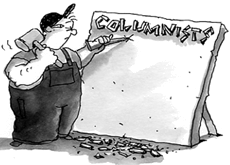





Disciplinary apparatus found wanting … Law Society in Phillip Street goes down three times in one week … Lawyers off the hook at the Bureau de Spank … Janek Drevikovsky reports

In 2015, the council at Phillip Street’s Lubyanka decided that it would lodge a complaint against solicitor Erica Brooke Taylor for alleged misappropriation of trust funds, among other trust-related irregularities.
The claimed misdeeds dated back to before 2015, and so fell under the old Legal Profession Act.
In 2018, the council resolved that Ms Taylor should be struck off the jam roll for professional misconduct. It applied to the NSW Civil and Administrative Tribunal for an order to that effect.
Without a complaint, the tribunal did not have jurisdiction.
Second, the complaint did not set out the alleged misconduct in sufficient detail.
And third, the complaint was not in writing.
The tribunal rejected all three arguments, and so Taylor lodged her appeal, which was unanimously upheld by justices Carolyn Simpson, Lucy McCallum and Robert Macfarlan.
“It is not the language of the making of a complaint; rather, the resolution is framed in the language of intention that a complaint be made.
I do not accept (as the tribunal did) that the resolution can properly be read as though it were ‘the following complaint ismade’. That is not the language chosen by the council.”
HH also agreed that the resolution failed to adequately detail the allegations against Taylor – it was little more than a bare list of the provisions she was said to have breached.
But the lawyer’s success on the jurisdictional points was enough. The court allowed the appeal and threw out the disciplinary case.
Another Sydney solicitor has escaped the might of the birching rod because, even though his conduct left “much to be desired”, there was no basis to conclude he had misused trust funds or breached undertakings.
According to the Court of Appeal, that meant the tribunal had been wrong to make a professional misconduct finding against Malcolm Carr, principal at boutique law shop Metro Lawyers.
The complaint against Carr concerned his work representing one Zvonko Nenadic, who was involved in a property dispute with his brother.
In late 2014, Carr briefed barrister Russell Sweet and then asked his client to pay up $7,900 in barrister’s fees.
The sum was credited to Mr Carr’s office account. From there, the lawyer paid $5000 over to the brief, with $2900 left over.
The client then transferred a further $3,127 to Carr’s office account, apparently to cover filing fees.
Soon after the client switched lawyers, taking the matter over to John Maait of Parramatta firm Norris Somers Maait.
In a letter to Carr, Mr Maait claimed some of the client’s money was still in his old lawyer’s trust account.
This was, strictly speaking, not correct – the only money Carr still had from Nenadic was in his firm’s general office account.
So he replied to Maait:
“We are holding no funds in trust because [the client] directed us to transfer the balance of all monies held on trust to him, which we did.”
Carr said he would transfer the $2,900 to the new lawyers.
Nearly three months went by without any sign of the money. Carr was reluctant to reply to the new lawyers’ emails, apparently acting on his insurer’s advice (or so he thought).
The council of the law society took the matter to the NCAT, which found Carr had attempted to mislead Maait into thinking he held none of the client’s funds, had misappropriated the $2,900 and $3,127, and had breached an undertaking to pay back the sums.
In the Court of Appeal, Richard White, Arthur Emmett and Lucy McCallum JA overturned these findings.
First, the court held that Carr had not made any undertaking to pay over the $2,900. Though he said he would pay the money into Maait’s account, it was impossible for him to do so unless he had instructions. Otherwise, the money had to go to the barrister.
Secondly, Carr had not intended to mislead Maait. When he wrote “we are holding no funds in trust”, he was referring to his firm’s trust account. He did not turn his mind to money paid by the client into the firm’s office account.
Finally, two of the judges, Emmett and McCallum, found that the lawyer did not misappropriate the $2,900. It was paid directly to Carr’s bank and was not used by the lawyer for any inappropriate purpose.
White JA thought the amount was misappropriated, because the lawyer benefited from its presence in his account.
At several points, the account’s balance was allowed to fall below $2,900. But for the presence of the money, the account would have been in overdraft.
Nonetheless, White found Mr Carr had not dishonestly misappropriated the money.
“That conduct was not the subject of any complaint. The complaints made by the Law Society in the application were not made out.”
Finally, the tribunal has refused to dole out a wet lettucing to a solicitor who simultaneously acted for an accused murderer and the police informant who was testifying against him.
The lawyer, given the pseudonym DWO, represented JB – a minor who was charged with murder in 2008.
After his arrest, JB told DWO he would not be making a statement to the police. But he did not tell the lawyer that, before his arrest, he had given some information to A107.
A107 relayed this information to the police. He had turned informant after being charged with two counts of making false statements to obtain money.
DWO represented A107 in his court matter. The lawyer’s evidence – accepted by the tribunal – was that he was at no point told that A107 was an informant in JB’s case.
When JB’s trial began, A107 was called as a prosecution witness. DWO instructed A107 to have no further contact with JB.
The DPP gave DWO a copy of A107’s “record of interview” in the JB case, but all references to A107’s status as an informant had been expunged.
JB was found guilty. His appeal failed, and he was refused special leave by the High Court.
In 2014, there was a statutory review into JB’s conviction. The attorney general conceded that A107’s informant-status had been kept from JB’s legal representatives.
JB’s conviction was quashed in 2016.
The law society brought misconduct proceedings against DWO, on the basis that he had been under a conflict of interest when representing both A107 and JB.
But DWO said the police had never given him the “affidavit of assistance” which recorded A107’s informant activities. The council conceded there was no evidence to the contrary.
The society applied for an early termination to the proceedings, which the tribunal granted.