





The port of call for pro-Israeli propaganda or retribution is The Australian.
So it was that Robert Gregory, chief executive of the Australian Jewish Association, ran to legal affairs writer Ellie Dudley and opinionista Janet Albrechtsen with the news that he had referred Sydney barrister Nicholas Poynder to the Legal Services Commissioner.
Poynder, a former officer of the Australian Human Rights Commission, had the temerity to post his opinions on social media about the war in Gaza – in particular the behaviour of the IDF generating snuff movies from the killing of civilians, and the apparent role of Hamas in humanitarian work for Palestinians (not for its atrocities in the October 2023 attack on Israel).
Gregory asserted that the barrister’s posts were seriously antisemitic and incited violence against the Jewish community.
Gregory’s complaint demanded that Poynder’s ticket be pulled as “not a fit and proper person” to practise as a barrister in NSW or as an officer of the court.
Poynder’s Twitter/X account has gone temporarily silent, but we managed to salvage some of the relevant posts and reposts …
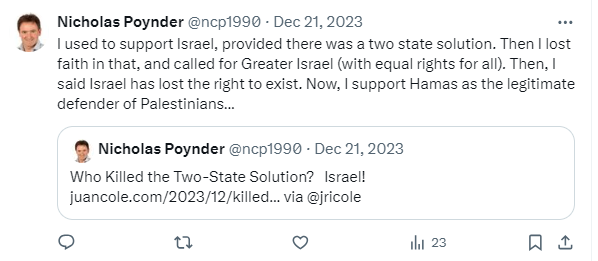


On February 22 Poynder rejoinded with a statement, the gist of which is that the newspaper and Gregory had taken lines from his materials out of context, and that his antagonism was directed at the genocidal activities of the IDF, representing the Israeli State, in Gaza, and not directed against Jewish people qua Jewish people.
See: Poynder’s rejoinder
That dismay at the activities of the State of Israel in its relations with Palestinians is not to be conflated with antisemitism seems to be an obvious point in debate on the current humanitarian disaster.
See for example the long essay by Pankaj Mishra “The Shoah after Gaza” in the latest London Review of Books. Mishra explores the long history of debate as to how far “recent” i.e. World War II history should be taken into account as a raison d’etre for the State of Israel.
The first president, Ben-Gurion, for example thought that Holocaust survivors were “bad, harsh and egotistic” (presumably reflecting on their ability to survive where millions did not). But Mishra explores how Israeli politicians from Begin onwards had turned to the Holocaust to justify Israeli militarism and expansionism.
The article’s other theme is the number of Jewish commentators who expressed emotions ranging from disquiet to disgust on realising that Israel was employing torture and prison camps that mirrored those of the Nazis.
Yet, Mr Gregory of the Australian Jewish Association asserted Israel’s position in “the fact that there was an unbroken Jewish presence in Israel for a period in excess of 3,000 years”.
Well, the Old Testament records that the Philistines (Palestinians) were also there then.

Gregory (right) at CPAC
All this seems a pathetic basis for demanding that a barrister be kicked off the jam roll.
Mr Gregory has a personal axe he is grinding in a fevered atmosphere, but what can be the excuse for the national broadsheet to hop in with a denunciation so adrift from the actual facts, singling out a barrister by name and address as hateful and deserving of condign punishment.
Nothing has yet been heard of the complaint to the LSC, but one trusts that Poynder’s chambers, Frederick Jordan, four square on Phillip Street and Martin Place, are standing firmly behind him, providing every support in what, in the modern era of mass trolling, is doubtless a very trying period.
I await confirmation of that necessary support.
≈ ≈ ≈
Media can, and most likely will be, untruthful by omission. I cite the coverage by The Whorestralian of Scott Morrison’s farewell speech to Parliament.
Not one word in pages of adulation about Morrison’s role in the Robodebt scandal, a role that began with his public assertion as minister in 2015 that he was a “welfare cop” – i.e. out to hound those in the welfare system, which froze the Department of Social Services so that it set aside its own internal legal advice as to the illegality of the algorithm-based impersonal pursuit system, as it also did with later external advisings from both government and the private sector.
It was Robodebt that set off the demands for Morrison to leave parliament. Historians of the future, on reading the News Corpse files, will see nothing attracting their eyes to this utterly unsavoury saga.
Scotty’s best shot was, at the time, to decry the conclusions of the Royal Commission as false.
He left Parliament, head high, proclaiming his faith in his God, who is no doubt hugely impressed at his capacity to assert the truth to be whatever he says it is at any given moment.
≈ ≈ ≈
“Sudden death syndrome” eh? Yep, it’ll get you every time. But any self-respecting State that expects to be taken seriously ensures coronial machinery to determine the actual cause of the “sudden death”, as opposed to merely labelling it a syndrome.
The next of kin and the public must receive this information, and, as any crime novelist will tell you, the deceased deserved it. And in modern Russia there are so many possibilities leading to sudden death: the KGB heart smack, good old novichok, or just an unfortunate succumbing to gravitational forces after leaping from a high window.
As Russia heads towards a (predetermined) presidential poll, the death of Alexey Navalny is a salutary reminder that “Democracy” isn’t just about having elections.
Far more is required for a people to claim they live in a democracy, and that apparatus constitutes the Rule of Law. Hence independent judges, a court system open to public scrutiny, State pathology to determine cause of (amongst others, political opponents’) deaths.
These are all machinery requirements dependent on the State. Freedom of speech and thought, evidenced in a free media, are matters that depend on the State for non-extinguishment, but are subject to insidious attack by commercial interests.
Russia and the Vatican eschew coroners (Popes don’t get an autopsy, which raised eyebrows on the death of Pope John-Paul I in 1978), but their importance in a State struggling to get on its democratic feet was made clear in 1987 in Kenya, then ruled by an (elected) despot, Daniel arap Moi.
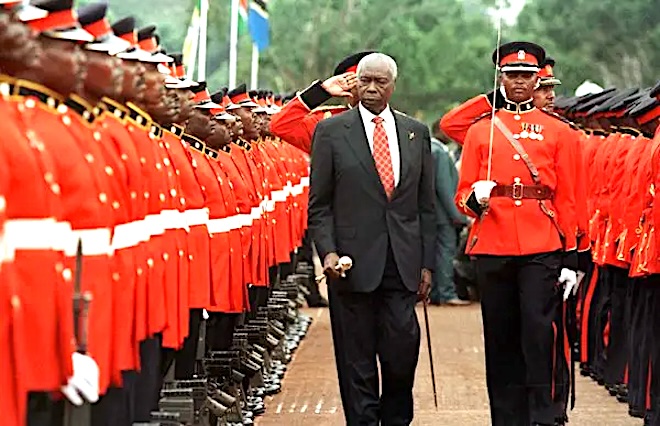
Moi: en garde
The Kenyan police took a leaf from the old boy’s book (nothing like autocracy to enable those down the food chain) and “disappeared” a villager they didn’t like.
The wife (illiterate and little knowing she was in fact a widow) appeared in the High Court seeking help in locating her husband.
The judge assigned to hear what quickly became a habeas corpus motion was Derek Schofield, one of a group of British based judges sent out as aid gifts, but only on 2½ year contracts (renewable) – so much for tenure.
The wife gave evidence that her husband had last been seen in the presence of police, so Schofield ordered the relevant officers to attend and give evidence.
Some duly turned up and stonewalled – they said the husband had been shot while escaping, but they didn’t know where the body was buried.
Schofield countered immediately: a fortnight to find the body, have it exhumed and provide a pathology report, or the Deputy Commissioner of Police would be ordered to court on a contempt charge.
The body was duly found, with a bullet hole indicating a frontal shooting. So much for evading arrest.
At that point Schofield was told by the Chief Justice that he “was off the case”, to which Schofield gamely replied that his decisions could be appealed, but only death could take him off the case once allocated to him.
The police then dug in, political pressure increased, and Schofield’s commission was terminated. The British government flew him and his Kenyan wife and children out to another judicial post in the Cayman Islands.
Schofield fell at a later hurdle when, as CJ of Gibraltar he clashed with the Governor and was sacked, but the 1987 saga in Kenya is still a reminder of how fundamental the public law apparatus of habeas corpus, public pathology and tenured judges is to a polity if not be overborne by executive power.
Kenya, assisted by this example, has slowly developed into a legally based nation since the departure of Moi in 2002.
South Australia on the other hand still hasn’t addressed the catastrophe of having a charlatan, Colin Mannock, as State Pathologist from 1968 to 1995.
Nearly 400 convictions rested on Manock’s dubious evidence, but few have been adequately challenged.