






The Ippster: encomiums at farewell
Your scribe notes that in a recent edition of this esteemed organ, the editor, no doubt with bated breath, searched the archives back exactly two decades to find the David Ipp story regarding bogus tort claimants.
The late Ippy, another peripatetic Seth Efrikan, made the NSW Court of Appeal his home from 2001, after first having colonised the WA Supreme Court.
He kicked off his time in the Premier State by chairing a Panel of Eminent Persons reporting on the scourge of tort claimants, the Panel producing a report that led to the Ipp Tort Amendments all over the country from 2002 to 2004.
Of the resulting alterations to tort law Ipp later blamed legislators for having gone further than his Panel’s recommended:
“Certain of the statutory barriers that plaintiffs now face are inordinately high … Small claims for personal injuries are a thing of the past. Establishing liability in connection with recreational activities has become difficult. Stringent caps on damages and costs penalties make most plaintiffs think twice before suing. Public authorities are given a host of novel and powerful defences that are in conflict with the notion that the Crown and government authorities should be treated before the law in the same way as an ordinary citizen. It is difficult to accept that public sentiment will allow all these changes to remain long-term features of the law.”
It was the upheaving of the law on negligence that made Ippy’s reliance on shock jock horror stories so relevant, a mere two years after the Eminent Persons reported.
Ipp apparently believed these far-fetched tales, or it at least affected his mind-set. He recounted to the 2004 conference of anaesthetists in Perth that a woman eating a hamburger spilled some coffee on herself and was able to sue McDonald’s for a poultice. This was the saga of Stella Liebeck, after whom the Stella Awards are named.
Stella’s story deserves at least context, and the relevant facts were available well before the speech to the anaesthetists: see e.g. “Java Jive” in (2001) 56 U Miami LR 113, where we find that Stella was the passenger in a car that picked up the cup of coffee from a McDonald’s drive through.
The critical facts were that the coffee arrived in Stella’s hands as per McDonald’s printed policy manual, about 90 degrees celsius from the urn, and McDonald’s had received hundreds of letters of complaint about coffee being served from takeaways at that temperature, and had settled a number of law suits on the subject.
Experts were called to explain that coffee at that temperature was inherently dangerous as likely to burn skin. Stella had placed the cup between her legs to get the lid off, when the coffee spilled. She suffered third degree burns to her inner thighs and parts adjacent.
The jury whacked McDonald’s with damages of $US2.4 million, which was reduced in private settlement to an undisclosed sum, to avoid delay arising from appeals. The jury based their quantum on the profit made by McDonalds from two days’ coffee trading in North America.
It’s depressing to think that reform of the law in the area of tort law was being driven by primal urges based in the global village whispers of the early days of the internet, when hard facts were available to debunk the nonsense.
Needless to say, Ippy took down his speech to the sleep doctors in less than a day once challenged by Media Watch. He didn’t like being publicly called out re his speeches any more than his judgments – see the encomiums poured on him at his Court of Appeal farewell that make no mention of Webster v Lampard (1992) 7 WAR 296 on the necessity of cross examining of police affidavits, reversed by the High in (1993) 177 CLR 598, or Great Lakes Shire Council v Dederer [2006] NSWCA 101 on liability in negligence, overturned by the High: see (2007) 234 CLR 330.
≈ ≈ ≈
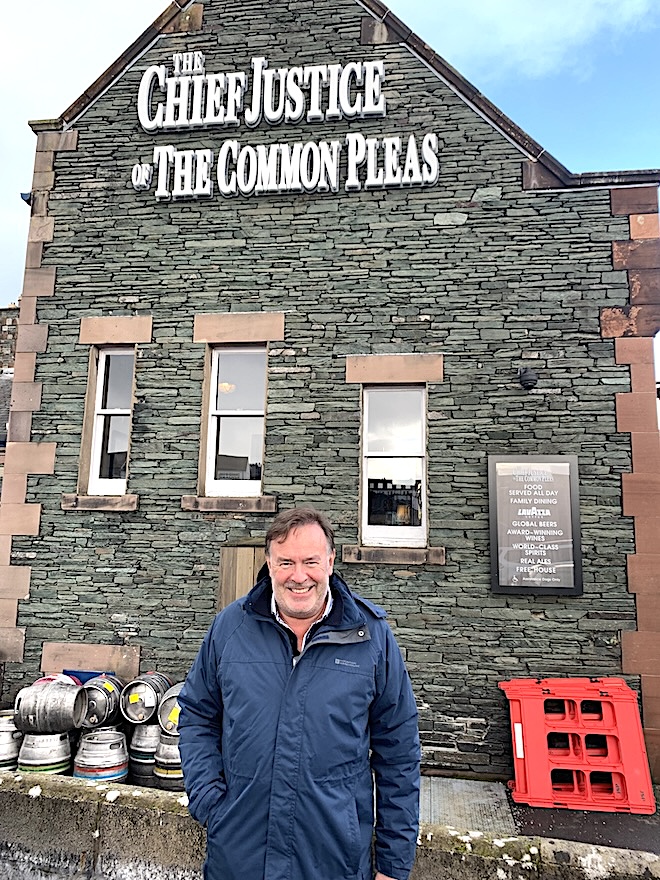
Geason J: sent off (photo Peter Lyons)
Also in a recent edition of our organ we find the story about the Tasmanian Full Court having to plough on as a two judge enterprise when Greg Geason J was sent off hors de combat.
The resulting decision was delivered in Blue Derby Wild Inc v Forest Practices Authority, Sustainable Timber Tasmania and Attorney-General (No 2)[2024] TASFC 1, by Martin AJ, Jago J agreeing.
Martin AJ seems to have set up shop in Mapland, after an exhilarating career that had him run the Snowtown murders trial in SA, then become Brian “Ten Goals” Martin CJ of the Northern Territory (ten on a Saturday afternoon for Sturt in his glory days, to distinguish him from his predecessor, confusingly also Brian Martin CJ), and in active retirement, gigs in WA (Lloyd Rayney’s murder trial) and now Tasmania.
The dramatis personae in the Full Court matter give the game away. Environmental protesters with the arse out of their pants clustered in a recently erected incorporated structure versus the State’s Forestry body (armed with “protective” licensing powers over commercial exploitation) and its commercial mate Sustainable ? Timber Tasmania, and to round it off, the AG.
Well, Brian M is not an old Crown prosecutor for nothing. The Greenies copped a flogging. To be fair, the Forest Practices Act 1985 loaded the dice with lashings of “self-regulation” for the timber enterprises setting out to exploit Tassie’s forests.

Brian (Ten Goals) Martin: No goal for the Greenies
Blue Derby made their first port of call a claim that there had been a lack of natural justice in decision-making as to permissions granted by the Authority to Sustainable Timber.
But if Blue Derby were to have a foot in the door at decision making, it needed to show its standing to demand judicial review of the decision to allow logging, and it failed at that first hurdle.
Both sides claimed support from the decision of the Victorian Court of Appeal in VicForests v Kinglake Friends of the Forest[2021] VSCA 195, where standing to an environmental group was allowed.
But the degree of dogged involvement required by such a group in a geographical area to gain recognition for standing is illustrated by the fact that soon after Kinglake, one of the judges in that case refused standing in a claim by another environmental claque, because it did not have sufficient attachment to the area and issues it was claiming to litigate. So it was with Blue Derby in Tasmania.
There’s a strong sense of déjà vu when sighting Tasmanian forest litigation (see eg Blow CJ in Tarkine National Coalition Incorporated v Director, Environment Protection Authority [2023] TASSC 3), the vu being back to WA litigation from late in the last century.
Out of step with what would soon be the more forward-looking High Court views on standing (eg Batemans Bay Local Aboriginal Land Council (1998) 194 CLR 247), the WA Full Court flattened the hopes of environmental protesters to gain the standing needed to even begin litigation over the decision making on forest use: see South West Forests Defence (1995) 86 LGERA 365 and Bridgetown/Greenbushes Friends (1997) 18 WAR 126.

Syd Shea: conservation program to protect the numbatIs there a modern day Tasmanian equivalent of the then Executive Director of WA’s CALM (Conservation and Land Management), the loquacious and unstoppable Syd Shea?
Despite occasional wins, forestry conservation groups still have hard graft just being heard in court. What would agitate this country sufficiently to follow New Zealand and India in giving specific geographical sites standing so that they may be “heard” in their own right in legal proceedings.
In NZ it’s the Whanganui River, and in India the rivers Ganga and Yamuna. The Kiwis legislated to reflect the importance of the Whanganui to Maori under the Treaty of Waitangi, and the Indian rivers achieved legal personality following orders made by a provincial High Court determined to protect rivers, sacred to Hindus, from further pollution.
I imagine a highly secular Australia sniffing at these justifications. The current basis for forest logging of our native (not exotic plantation timber) involves the simple juxtaposition of a government department in the relevant State controlling the rights to forest access, happily disposed to proposals from timber enterprises to fell the forest to turn a quid, and no interlocutor to speak for the welfare of the forests.
It might be noted that this isn’t just a matter of “tree hugging”. The deforestation of WA was so successful that Dr Shea, as general manager of CALM, set up a conservation program to protect the State’s animal emblem, the numbat (a sort of striped bandicoot), a forest-dweller facing extinction.
Shea was sufficiently adroit to see the likely backlash if he and his commercial partners, Bunnings (part of Wesfarmers) and others, were held responsible for offing a cute and visually iconic marsupial.
The point is that clear felling native forests impacts massively on a whole fragile ecology. Has Tasmania got a Shea inside the Forest Practices Authority who is addressing the impact of logging on wild-life and looking out for special protection?
Too late for the thylacine, but which species will be next?