








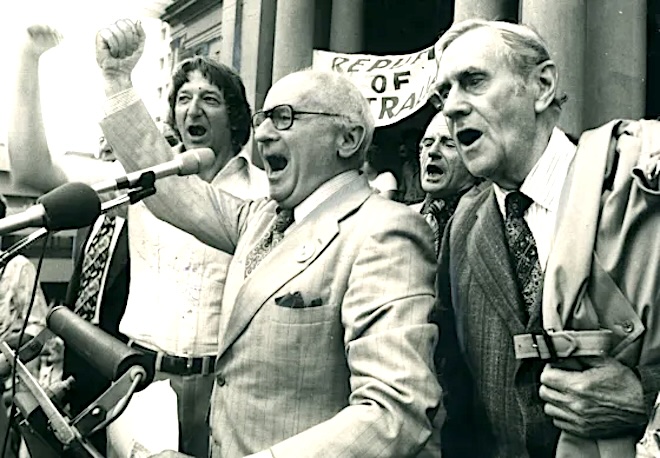
Horne and Patrick White on the stump
The soul of a nation. Where does one find it? It’s 60 years since Donald Horne acerbically noted in The Lucky Country that:
“Australia is a lucky country run mainly by second rate people who share its luck. It lives on other people’s ideas, and, although its ordinary people are adaptable, most of its leaders (in all fields) so lack curiosity about the events that surround them that they are often taken by surprise.”
Horne noted that Australia’s economic prosperity was largely derived from its rich natural resources and immigration, observing that Australia “showed less enterprise than almost any other prosperous industrial society”.
Well, it could have been worse. Robbie Burns wrote of the Great and the Good among his countrymen: “Such a Parcel of Rogues in a Nation.”
Things can’t be as bad here as they were in 1964, surely. I mean, we’ve all (?) rejoiced in Mabo and the subsequent improvement in race relations in this country.
We have annual reports tabled in the Commonwealth Parliament on Closing the Gap, i.e. measuring the discrepancies between Aboriginal and mainstream Australian life styles in health, education and longevity.
The gap never closes to any significant degree, but we, mainstream Australia, prove our good faith by quantifying the disparities between the two groups, year in year out, always hoping that somehow (if we throw enough money at the problem) equality of outcomes will occur.
And equality is our mantra, never recognition by the mainstream of Aboriginal culture, beyond being glad that American collectors pay big money for indigenous art.
The lip service paid to Mabo is writ large when the approach of our courts to claims for Aboriginal fishing are compared with that of the New Zealand court system in taking account of indigenous culture. The Kiwis do not focus on simplistic assertions of “equality of treatment proves we’re being even handed”. See the NZ Supreme Court decision in Smith v Fonterra Co-operative[2024] NZSC 5 for a successful appeal allowing a claim to be struck back in that Maori culture had to be taken into account against Fonterra for tortious damage arising as a result of climate change, consequent on the company’s fossil fuel activities.
The case can now go to trial, the Supreme Court (Helen Winckelmann CJ, Susan Glazebook, Ellen France, Joe Williams and Stephen Kos JJ – Williams J being a Maori) having been anxious to note that it was not pre-empting the result, merely allowing the claim to proceed by reference to Maori culture and tikanga (traditional Maori values).

Williams J, NZ Supremes
Contrariwise, the fishing cases in Australia post-Mabo provide a relentless determination by State appellate courts to put blackfellas on the back foot in claiming any right to fish in a customary manner.
Yet, doesn’t the Native Title Actat ss. 211 and 223 provide for customary fishing, for family or personal needs, provided it’s not for a commercial purpose?
Yes it does, but the case law for implementing these provisions is relentlessly opposed to Aboriginal claims, stemming back to a post-Mabo but pre-Native Title Actdecision, Mason v Tritton (1994) 34 NSWLR 572, the product of a peculiarly potent Court of Appeal comprising Gleeson CJ, Kirby P and Priestley JA.
Despite the evidence of anthropologists to the convicting magistrate as to the customary activities of NSW south coast Aborigines in abalone fishing, the CA was having none of the Mabo claims put forward.
The Smiler was of the view that people anywhere in the world living on a coast “dropped a line”, so it was not enough to claim that the appellant’s ancestors had always provided for family and clan by abalone fishing.
There had to be some metes and bounds to the taking of the marine produce so that the fishing could be recognised as in accordance with the “traditional laws acknowledged by and the traditional customs observed by” the relevant indigenous group, that being a rubric used by Brennan J in Mabo in the context of a claim to native title to land.
The CJ might be thought to have been a bit unbending, but St Michael of Kirby and Bill Priestley could have been more reflective on the recognition of indigenous culture, but were not.

Gleeson, unbending
The collective message was that a claim to take fish contrary to NSW regulations had to be supported by evidence of the geographical extent of the particular group’s claim; the exclusivity of the group in taking marine produce from that area; proving who had the right to take the fish and what was done to the fish etc.
None of this reflected on the holistic concept of Aboriginal culture associated with particular land and waters, and the process of living in that particular environment.
The Native Title Act commenced soon after Mason v Tritton and employed the wording of Brennan J re laws and customs (delivered in a land claim context) as markers for acceptable fishing and hunting beyond the boundaries of State laws.
The scene was now set for ever more legalistic restriction of attempts to assert indigenous rights to fish, usually involving abalone.
This approach hit its straps in Dillon v Davies(1998) 8 TasR 229 where (at 238) Underwood J accepted that the convicting magistrate had received evidence that fishing abalone had been an aspect of indigenous life in Tasmania “since time immemorial”.
However, HH knocked out the claim to take abalone on cultural terms by reference to (1) lack of evidence that abalone fishing was a central and significant part of aboriginal custom (relying on Van der Peet(1996) 109 CCC (3d) 1, Canadian Supreme Court); and (2) a lack of evidence as to the extent of the traditional law or custom pursuant to which the abalone were taken (the Mason v Tritton point).

Justice (Hollywood Pete) Underwood
Van der Peet was later overturned in the Canadian Supreme Court (see Sappier(2006) 274 DLR (4th) 75) on the aspect of required centrality to indigenous culture, but subsequent Australian cases happily follow Dillon v Davies without a backward look.
Counsel’s plaintive submission that “the taking of abalone was an important part of the sustenance of the Aboriginal people and for that reason alone it was part of their culture” was rejected as not in accordance with Mabo(a clear reading of which does not support the requirement of a proven legal system for a usufructuary claim) or Van der Peet.
The most recent decision in the field really nails the coffin down in the best legalistic fashion. The SA Court of Appeal (los tres amigos Livesey P, Doyle and Bleby JJA), known for their warm and fuzzy approach to those floundering in society’s deeper waters e.g. Disorganised Developments v South Australia(overturned by the High Court at [2023] HCA 22; Webb v Dept Correctional Services(special leave pending); and Hegarty v Keogh (No 2)(special leave refused).
The amigos also gave us Dietman v Karpany, recording the success of the head of the department running fisheries, Peter Dietman, over the would be taker of abalone in aboriginal customary fashion, Andrew Karpany.
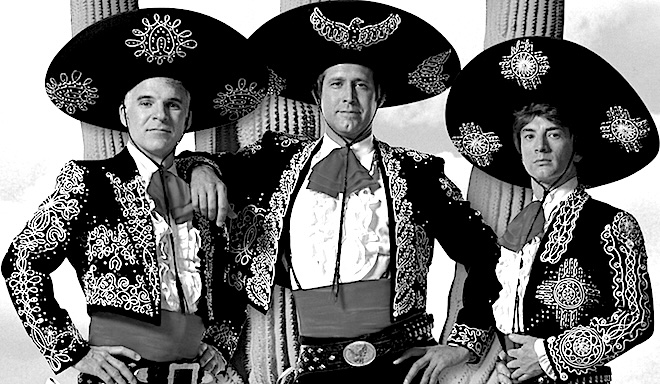
Three Amigos, nails in the coffin
The CA rounded up all the precedents with a view to tackling the big question: did an Aboriginal claimant to the “protection” of the Native Title Actfrom the regulatory reach of State law have to prove their customary rights at an evidentiary level – i.e. merely raise the claim to a plausible level requiring rebuttal by the prosecution; or did they have to prove their customary rights in the form of a statutory defence at a persuasive level i.e. on the balance of probabilities?
Needless to say, case after case has involved a conga line of anthropologists attempting to establish the historical actions of a particular indigenous group relevant to their fishing activities, to no effect.
And needless to say, after the ritual obeisance to the Native Title Act being remedial, the amigos determined that blackfellas would have to prove their customary rights to fish on at least the balance of probabilities, something which no one has done thus far.
The reason for that lack of success is that Australian Aboriginal custom is not apt to be measured and produced by the yard like Anglo-Australian law.
It involves the entire experience of a group in living with particular land and water, exactly as alluded to by the NZ Supreme Court in Smith.
It is beyond galling that the SA CA in Dietman could quote the High Court in WA v Commonwealth on the effect of s.211 of the Native Title Act, promising customary hunting and fishing rights:
“… the effect of s.211 is not to control the exercise of State legislative power, but to exclude laws made in exercise of that power (inter alia) from affecting the freedom of native title holders to enjoy the usufructuary rights referred to in s.211.”
Maori custom and tikanga is accepted in New Zealand law as a clear measuring stick, uncluttered by evidentiary nostrums (yes, there’s a high level of acceptance, lacking in this country) while Australian Aboriginal custom is niggled to death on the rack of onus and proof, in a total absence of primacy allowed to that custom.
The best it can hope for is to carve a rebate from State regulation, which State judges never allow.
The soul of two nations writ large.