





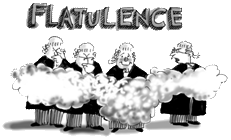


NT DPP is the law … CLP fund raiser not prosecuted for alleged breaches of the Electoral Act … Not in the public interest … Prosecution of person accused of sexually abusing Aboriginal children also dropped … Not in the public interest … Dishing out the nollies … Buffalo Bruce reports from Darwin
 Top End prosecutors have been the subject of robust criticism in two recent instances over their failure to take action in significant cases.
First, we’ve had the Labor opposition in a frightful state because the DPP has decided not to prosecute the Country Liberal Party’s slush fund, Foundation 51, for alleged breaches of the Electoral Act.
NT police issued a statement on October 21 saying its special reference unit has completed its investigations into the company and provided a brief of evidence to the DPP.
“The DPP has determined that, notwithstanding a prima facie case and reasonable prospects of conviction, it is not in the public interest to commence a prosecution against Foundation 51 Pty Ltd. The investigation is now complete.”
Foundation 51 reached a high point of notoriety when it was revealed that one of its directors was NT magistrate Peter Maley, appointed to the bench on the recommendation of his pal, attorney general, John Elferink.
Maley even made a $5,000 donation to the Elf’s election campaign.
As I reported in August last year one of the issues that concerned the local bar association was the suggestion that CLP donors might have appeared as litigants before Maley, without the conflict being disclosed.
Maley only stepped down from the board of Foundation 51 after the Opposition started making a fuss in parliament about his breach of ethics as a madge.
The police had evidence that the company had not disclosed that it was an “associated entity” with the Country Liberals.
After the Electoral Commission made inquiries, Foundation 51 lodged three associated entity annual returns, one of which was within time and two were out of time.
A backlog of annual reports filed by Foundation 51 shows it received more than $700,000 in donations and contributed $200,000 of “in-kind advice” to the CLP.
Clearly, it’s a touchy political matter. Opposition leader Michael Gunner said that the failure to prosecute “sends an appalling signal to the community”.
The Elf says it’s a minor matter and that filing late or misleading returns would only lead to a fine, so why bother.
At first the ODPP refused to explain its reasons why it was not in the public interest to prosecute the company. Certainly, it is in the interests of the CLP for the DPP not to take the case to court, and in the NT that is sometimes the same thing as “the public interest”.
After agitation by the NT News the DPP eventually explained that there should be no prosecution because Foundation 51 had disclosed its financial returns while the police were investigating and by the time the brief of evidence was received, everything was in order.
Some Darwin lawyers muttered that this justification was akin to saying, “we won’t prosecute a bank robber, because he’s given the money back”!
In a statement on its “role and mission” the ODPP says there is no “inflexible rule” against publishing reasons for declining to prosecute, particularly in instances where there is a significant public interest.
The home was established in 1946 by the Australian Indigenous Ministries and licensed by the Commonwealth government, which was also the guardian of some of the young residents. It was an institution for the “maintenance, custody and care of aboriginal and half-caste children”.
Many of the children now identify themselves as members of the stolen generation.
Case study 17 by the Royal Commission into Institutional Responses to Child Sexual Abuse delves into the rapes, beatings and other abuse of Aboriginal children at the Retta Dixon Home and the failure of the NT ODPP to bring to trial the main alleged perpetrator, one of the home’s “house parents”, Donald Bruce Henderson.
The royal commission heard evidence of physical and sexual abuse of the children – some were chained to their beds, tied to a clothes line, “raped in the chook house”, burnt with hot water and, in one instance, faeces were rubbed into the face of a young resident.
Henderson was known by the children as “Ticklefoot”. He was accused of sodomising boys and beating children on a daily basis. One witness gave evidence that he used to place her feet on his penis until he became aroused, or bounce them on his lap for the same end.
Complaints to the superintendent of the home, Mervyn Pattemore, went unheeded. All of this was going on in the 1960s and 1970s.
Despite the occasional cursory investigation, Henderson kept his job and nothing was reported to the police.
However, in 1975 further allegations were raised and Henderson was charged with sexual offences against five children at the home.
None of the charges went to trial, although Henderson did resign.
In 1998 a former resident complained to the police about Henderson’s sexual abuse and in June 2001 he was charged again, after others came forward, with 79 counts of sexual offences and one count of assault occasioning actual bodily harm.
Later the number of counts was reduced because a complainant had died.
Detective Roger Newman led the investigation and his brief of evidence went to the DPP.
In March 2002 Henderson was arraigned in the NT Supreme Court on 15 counts, to which he pleaded not guilty.
In September that year Glen Dooley from the ODPP sent an email to the Director of Public Prosecutions, Rex Wild QC, the deputy director, Jack Karczewski QC, and senior prosecutors Michael Carey and Ron Noble.
Karczewski is now the DPP and Carey the deputy chief magistrate of the NT.
On October 29, 2002, Dooley emailed detective Newman advising him of an application by Henderson for separate trials.
The royal commission reported that Newman, “never recalled seeing an application and there was never any suggestion to him from the DPP that this was a reason for the matter to be discontinued”.
His opinion on the application was not sought and nor were the opinions of the victims. On November 11 that year, senior prosecutor Carey recommended that the prosecution be discontinued on the basis that there were no reasonable prospects of conviction.
He claimed that the separate trials issue diminished the chance of success. Dooley agreed with this assessment, as did Wild.
Within 24 hours a nolle prosequi was entered on all charges and the prosecution was discontinued, on the grounds of:
“The latent ambiguity in the charges … the multiplicity of offences with nothing to identify any one of them as the offence with which the accused was charged in any particular count … the staleness of the offences … the inconsistency between the witnesses and within the testimony of each particular witness.”
Carey’s recommendation to drop the case did not comply with the DPP guidelines, and he “could provide no reason [to the commission] for failing to comply with the guidelines”.
Carey conceded that his 2002 memo failed to meet the guidelines.
Karczewski added that the “latent ambiguity” did not apply to all the counts and that in five counts the DPP was wrong to have entered the nolle prosequi.
He also told the royal commission that if the same case were presented to him today, he would not see any reason not to proceed. It was “crystal clear” that there was sufficient evidence to charge and to proceed with those charges.
The DPP guidelines also require the police officer in charge of the investigation and the victims to be notified of discontinuation as soon as practicable after the decision.
Neither the victims nor detective Newman were notified about this development until November 27 – two weeks later.
Royal Commissioner Peter McClellan said the NT DPP had committed a “serious failure to observe appropriate procedure” in the Henderson case.
During the public hearing the Commonwealth accepted that it had a general responsibility to the children in the home, which closed in 1980. However, the commission made no findings as to whether the Commonwealth failed in its duty of care – “given the passage of time and the inadequate state of the records”.
A submission to the commission from siblings of Henderson, now 79-years of age, said he never had a sexual relationship with his wife, Barbara, even though they were still married.
Civil proceedings against Henderson have been commenced by some of the victims.
More:
Article by NT barrister John Lawrence SC on Aborigines in the territory’s justice system
High Court decision upholding wide powers for NT police to arrest and detain Aborigines on “reasonable suspicion”