





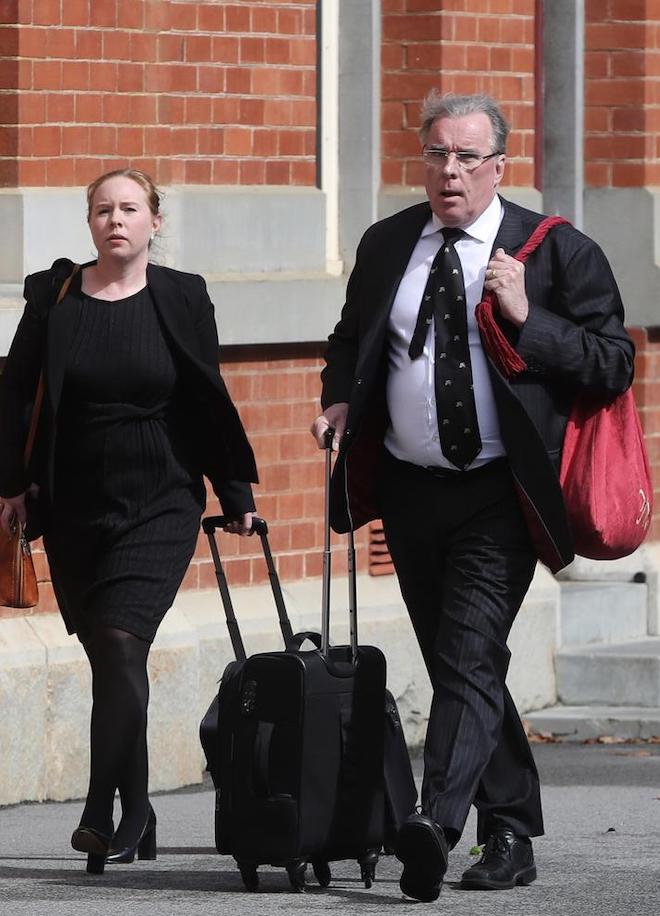
Bennett: grossly careless
Prominent Perth lawyer Martin Bennett has been fined $23,000 in the WA State Administrative Tribunal after a professional misconduct and unsatisfactory professional conduct claim was brought against him by the Legal Services and Complaints Committee.
Bennett, the founding principle of the eponymous law shop, was found to have unlawfully disclosed privileged information during a guardianship application in the WA SC.
His high-profile clients have included murder-accused Crown Prosecutor Lloyd Rayney, and mining magnate Chris Ellison. Currently he is acting for Senator Linda Reynolds, who is gearing up for a defamation claim against rape victim Brittany Higgins and her boyfriend David Sharaz.
Bennett, who has been plying the trade for almost five decades, permitted his client to affirm an affidavit which contained information on the mental health of the client’s father (who was the subject of the guardianship proceedings).
This information was obtained during a previous tribunal matter, and was subject to orders limiting its use in later litigation.
A three-member bench, which included Deputy President Judge Henry Jackson, found that Bennett was “grossly careless” when he permitted his client to affirm the affidavit.
Though Bennett believed that the information could be disclosed under the orders, he failed to verify his belief – even after a senior associate at the firm twice questioned whether the protected information should be included in the affidavit.
While both parties settled that Bennett should be disciplined for professional misconduct by way of gross carelessness, the panel suggested that he could be liable on the more punitive basis of recklessness – which would lead to a finding of serious misconduct.
The tribunal stated that as a “very experienced practitioner”, Bennett’s failure to verify the accuracy of his belief reflected a “conscious disregard for the correct view of the law”.
In excoriating his lack of further research or inquiry on the issue, the bench discussed how his conduct potentially reflected greater culpability than the gross carelessness standard of merely failing to do “what should have been done”.
In respect of the senior associate’s concerns about the affidavit, the bench noted:
“It seems quite remarkable to suggest that the practitioner did not even acknowledge the possibility that he was wrong in his view when the SA twice presented him with her concerns.”
Despite a lengthy discussion on the likelihood that a recklessness finding could be made out, the tribunal acceded to the parties’ agreement that Bennett be liable for gross carelessness rather than recklessness – although there were “considerable misgivings” in doing so.
Recklessness was not entirely ruled out – with the observation that “we are not satisfied that that position was not realistically possible”.
In addition to the improper disclosure, Bennett was found liable on a second count of professional misconduct after he wrote to the WA Attorney General requesting an intervention against a charitable trust connected to the family of his clients.
The letter made reference to information obtained during discovery in Supreme Court proceedings, and which had not yet been tendered in court.
This was in breach of the Harman obligation to not use court documents for an ulterior purpose.
Bennett was also found to have engaged in one count of unsatisfactory professional conduct, after he carelessly failed to clearly and fully explain matters addressed in an affidavit tendered to the tribunal.
In a subsequent application to vary the original orders delimiting the use of the privileged health information, Bennett “did not clearly and fully explain” how the protected information had been disclosed in the impugned client affidavit.
It was noted how the lack of detail could have led the tribunal into substantial error.
Alongside the $23,000 fine, Bennett was ordered to pay a fixed costs amount to the tune of $12,500.