





Hong Kong … National Security Law … Court of Final Appeal … Judicial independence … Are the non-permanent judges compromised? … Reassessment following Spigelman’s departure … Australian judges cling on … Alan Zheng reports
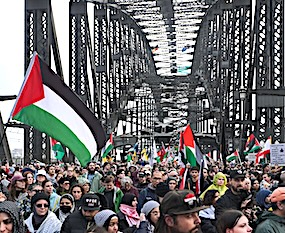
With every day that passes, the first limb of that sentiment has been cast in doubt. Two years on from fierce anti-government protests that rocked the city, democracy activists are on retreat.
Many have chanced the choppy seas on rickety boats in an effort to escape to Taiwan and flee arrest under the National Security Law, but to no avail. Bank accounts have been frozen, lawyers have been arrested and bail has been refused for former political candidates and campaigners alike.
Yet, for some, fleeing the harbour’s neon lights and urban verticality has proven to be a smoother process.
It remains to be seen whether HK will ever leave Jim Spigelman after he resigned from his posting in Hong Kong’s highest court – the Court of Final Appeal (CFA) – at the end of 2020, citing the “content of the national security legislation” which has been variously described as “sweeping … expansive [and] over-broad” in its criminalisation of secession, subversion, sedition and collusion with foreign forces on pain of life imprisonment.
Article 23 of Hong Kong’s Basic Law provides that Hong Kong shall enact “laws on its own” for the region’s security.
The National Security Law (properly known as the Law of the People’s Republic of China for Safeguarding National Security in the Hong Kong Special Administrative Region) was approved and enacted by Beijing in mid-2020 purporting to be in accordance with Article 23.
Amongst the Law’s objects are to ensure “resolute, full and faithful implementation” of the One Country Two Systems model, safeguard national security and to prevent, suppress and impose punishment for offences endangering national security in HK.
Though the text explicitly indicates it does not abrogate the presumption of innocence and any human rights in Hong Kong (Art. 4 and 5), concerns have been raised by the United Nations and human rights NGOs over the practical application of the Law and its imposed obligation on persons to “not engage in any act or activity which endangers national security” (Art. 6).
The Law also provides that judges who make “any statement or behave in any manner endangering national security during the term in office” will not be able to adjudicate cases concerning offences endangering national security (Art. 44).
In an odd twist of history, the National Security Law and its implementation by Beijing rather than the local HK government echoed the 1967 riots in Hong Kong against colonial rule. Then, Chinese communism was the catalyst behind protest sentiment and the British colonial government considered security laws to clampdown on protesters.
Against this backdrop, Hong Kong’s cauldron of political turmoil and disarray has been spilling over into the ranks of its own judiciary with confidence in its independence waning alongside the rule of law in the territory.
On the Court of Final Appeal’s roster are judges from various common law jurisdictions in the Commonwealth. Among them still are three Australians – Murray Gleeson, William Gummow and Robert French – outnumbered but not outclassed by a Canadian and nine UK law lords, including Scottish lawyer Lord Patrick Hodge of the UK Supreme Court who promptly filled the vacancy left by Spigelman.
The arrangement finds its source in the 1997 Handover and an agreement between then Lord Chancellor Lord Irvine and Hong Kong’s Chief Justice Andrew Li and sees freshly retired Australian judges take their talents overseas and set up digs in HK for up to a month every year.
In total, they serve a term of three years unless extended on the recommendation of the Chief Justice.
It is unclear whether Australian judges receive remuneration for their time, however the CFA’s arrangement with the UK Supreme Court – where a fee is instead paid to the UK Supreme Court – suggests otherwise.
In the past, High Court justices Mason, Dawson, Brennan and McHugh also served on the CFA. Mason served on the court longer, and perhaps with more enthusiasm than many of his peers – for 18 years between 1997 and 2015, ultimately retiring at the age of 91.
During this time, he heard 106 appeals, wrote or joined in on 34 majority opinions and wrote 8 concurring opinions between 1997 and 2010.
The roster follows a rotating system where a non-permanent judge sits on every case in the CFA during the year alongside a bench of five typically constituted by the Chief Justice and three permanent judges.
The NPJs (as they’re stylised) were not as busy on the court in 2020, in part due to the disruption brought by COVID-19.
According to searches on HKLii, Gleeson delivered a judgment on two matters while Gummow chocked up one judgment quashing a conviction and ordering a retrial for the Crafar farms scam in New Zealand). Meanwhile, French had none.
None of the Australians have sat in matters concerning the National Security Law, the main dispensation of which is subject to Chief Executive Carrie Lam’s designation of particular judges, the first instance jurisdiction of magistrates and district courts and, in some cases, transfer of proceedings to trial in Mainland courts.
In his address opening the 2021 law term, Hong Kong’s Chief Justice Andrew Cheung credited the “substantial contribution made by [Hong Kong’s] overseas Non-Permanent Judges to the work of the court despite occasional difficulties in recruitment for judges … in recent times”.
In truth, those difficulties have been less occasional and more or less sustained since Spigelman’s departure.
Word from Her Majesty’s former colonies travels fast. An Australian jurist has left Hong Kong. The question came rough and ready. Should we pull our people out too?
Yes, came the clarion call from some, mostly political, quarters in London. The issue has been handled by the Foreign Office, in “consultation” with the UK Supreme Court and judges have been accused of “giv[ing] cover to what is a totalitarian regime“.
The President of the UK Supreme Court Lord Reed expressed concerns over the National Security Law in mid-2020, specifically questioning whether it was consistent with Article 85 of Hong Kong’s Basic Law which provides that Hong Kong’s courts shall exercise judicial power independently and free from any interference.
“[The UK Supreme Court] will continue to assess the position in Hong Kong as it develops, in discussion with the UK Government. Whether judges of the Supreme Court can continue to serve as judges in Hong Kong will depend on whether such service remains compatible with judicial independence and the rule of law.”
Lord Reed went further more recently indicating that he would meet with the UK Foreign Secretary Dominic Raab to discuss the future of British NPJs in Hong Kong. He said:
“If there was any undermining of the independence of the Hong Kong judiciary, or if it was expected to act contrary to rule of law, or if simply the situation in Hong Kong became one where we could no longer in good conscience serve there, then I would no longer be prepared to serve or to nominate other judges of the court to serve there.”
In mourning the loss of judicial independence in HK, Britain’s politicians have trod perilously close to overriding the judicial independence of their own judiciary.
At least, that’s been the view from the other side of the fence.
Hong Kong’s Chief Executive Carrie Lam deployed all the tools of textual interpretation at her disposal. Lord Reed’s use of the conditional conjunction “if” in his statement, Lam suggested, meant the subsequent descriptions of eroded judicial independence and the rule of law were “not today’s situation“.
Joining Lam in the opposing corner was Hong Kong’s Secretary for Justice Teresa Cheng who argued that the local HK government and Beijing had not interfered with judicial independence in Hong Kong.
Meanwhile, Lord Sumption, one of the newer faces in the harbour city after his appointment as an NPJ in 2019, took to The Times to urge Britain to avoid politicising the court and dragging judges into a political boycott.
“The problem about these demands is that they do not distinguish between democracy and the rule of law. Democracy has never existed in Hong Kong, but the rule of law has and still does … As a Hong Kong judge, I serve Hong Kong people … I must be guided by their interests, and not by the wishes of UK politicians.”
Sumption’s piece was just as much targeted to the political class as it was to The Times itself which published an editorial describing the continuation of British judges in HK as “lend[ing] their authority to a compromised system”.
It is not as if NPJs have been part of the judicial furniture and little else.
In 2018, Lord Hoffmann quashed the imprisonment terms dished out by a lower court to democracy activists, including protest leader Joshua Wong. Lord Nicholls provided a famously reasoned judgment on the defence of fair comment which attracted four concurring opinions in Cheng v Tse.
Australian judges have also played a role in developing the law in relation to environmental noise restrictions, directors’ duties and the duties of care owed to construction workers.
Mason, in particular, is said to have contributed a great deal of clarity to the interpretation of Hong Kong’s Basic Law and the constitutionality of restrictions on freedom of assembly and speech.
Alas, dramas have not germinated in the judiciary alone.
In the barristers’ branch of the profession, British QC David Perry was criticised after agreeing to prosecute democracy activists in Hong Kong under an unlawful assembly law preceding the national security law.
The criticism came despite his supporters claiming that his actions were an entirely normal consequence of the cab rank rule which operated due to Perry’s registration with the Hong Kong Bar.
The debate shows no sign of quietening down at the time of writing and an exodus of British judges from HK remains very much on the cards.
The one Canadian on the court, former Canadian Chief Justice Beverley McLachlin, has faced more lukewarm calls for her resignation from her role in HK.
An Ontario Law Society motion to call for her resignation was defeated 28-17 last month and a Bencher (a member of the board of directors of a provincial law society in Canada) described the motion as “effectively interfering with judicial independence”.
McLachlin’s view has remained unchanged:
“As far as I can see from my experience, the judges on the Court of Final Appeal are totally impartial … whether I add any impartiality [to] the particular cases I have heard, I don’t know, but I do believe that there is perhaps some value, from the point of view of the public confidence in the system, to know that there are jurists from other countries who want to sit there.”
While debate between the Brits has raged and various forms of dissent crushed in Hong Kong, Gleeson’s term on the CFA was quietly renewed for another three years in March.
To date, there have been no public calls for Gleeson, Gummow and French to resign from their roles on the CFA in Australia.
French has been on the record to state his continuation on the court reflects his support for the other justices and belief in their capacity to give effect to judicial independence in Hong Kong.
About Hong Kong’s culinary scene it has been said that “nothing is truly foreign and nothing doesn’t belong”.
Like its food, culture and history, the status of judicial independence in Hong Kong is in this liminal state.
Where it goes from here is anyone’s guess.