


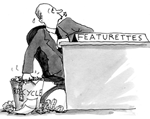

The whacky world of “Sovereign Citizens” … Conspiracy theorists and God’s chosen few join forces to challenge authority … Principles and precedents defenestrated as the Constitution and the common law get a psychedelic varnish … Judges in the “trustee position” … Alan Zheng investigates

They’ve been on the rise for a while now.
They reject the authority of the law, government and all its manifestations – particularly law enforcement and tax agencies – usually because of magical and misguided applications of the Constitution and the common law or legal reasoning beyond the bizarre.
These are laypeople who – armed with zero legal training – have devising legal submissions to challenge coppers and other miscellaneous forces of the state.
They regard themselves as answerable not to the traditional authority of the law and the state but only to their own interpretation of legal duties.
Naturally, the movement started in the United States, but it has caught on in Commonwealth countries – and it has a head of steam.
There are many of their genus in the US, with some estimates of around 300,000 sovereign citizens, with adherents sharing ideological roots in anti-tax movements, conspiracy cults, white supremacists and religious groups.
Make of that what you will.
Roberts has since denied identifying as a sovereign citizen.
Forget the venn diagram comparing climate change deniers and sovereign citizens. They are one and the same, and Roberts is exhibit A on point.
Roberts living soul/corporation combination has been such a headache overseas that in a Canadian decision, Meads v Meads, the Court of the Queen’s Bench of Alberta included sovereign citizens under a category labelled Organised Pseudolegal Commercial Argument Litigants (OPCALs).
OPCALs employ techniques to disrupt court operations and in the process frustrate the legal rights of their opponents.
In Meads, Associate Chief Justice John Rooke heard submissions from Mr Meads, a sovereign citizen, who claimed he was simultaneously a “corporate identity” and a “child of God.”
This, he said, meant he was free from his obligation to pay spousal and child support payments to his wife. Poor Mrs Meads.
The court held – based on the absurdity of the documents filed by Mr Meads – that the claim was vexatious and there was no precedent in which any principle advanced by an OPCAL had ever been given credence by a Canadian court.
There are various eccectric alternative positions about the way the law should work, which should not necessarily be confused with Sovereign Citizens – as we see here:
America paints a far more concerning portrait of these citizens.
Sovereign citizens have murdered numerous law enforcement officers and in 2015 were labelled the number one domestic terrorist threat, according to the Department of Homeland Security.
Closer to home, the creation of fake nations, like the now-closed Principality of the Hutt River in WA embody sovereign citizenship taken to its extremities.
In 2016, Justice Peter Garling of the NSW Supreme Court heard an application by the ATO seeking to recover income tax in excess of $1.5 million owed by Garry Bonaccorso.
The ATO sought to strike out Bonaccorso’s defence because the pleadings were embarrassing and contained “unintelligible and irrelevant considerations”.
Bonaccorso didn’t attend the hearing, but in his pleadings he had cited passages of the Bible, ancient Latin maxims, the Encyclopaedia Britannica, Magna Carta, an anonymous source and an “Essay on Trial by Jury” by the anarchic Lysander Spooner, among other things.
Bonaccorso argued he was not liable to pay the tax because he was a “subject of the Queen of the United Kingdom” and neither an employee of the ATO or a “citizen of the Queen of Australia.”
The upshot of his argument was that his status as a “person” under tax laws was a “violation of contract law and a trespass upon [his] life and property”.
In other, no less confusing, words, this meant Garry Bonaccorso is a “created fiction”.
It followed that he did not “partake in the Fraud which is being thrust upon the subject Garry:Bonaccorso through the Commonwealth of Australia registered with the US Securities Exchange Commission”. [Note the weird placement of colons by these citizens in identifying themselves.]
It was all fun and games until the court agreed with the ATO and struck out the defence. Most sovereign citizen interactions tend to start and end the same way in Australia.
For a moment, the citizen has gained the upper hand while the copper is flummoxed. Then another police officer appears at the scene and says that RBT is being conducted under the Road Traffic Act.
Properly deployed through cross-examination young constables have been advised:
“When the word ‘crown’ was taken out of the constitution in 2004 and replaced with the words ‘de facto monarch’ in the state of Western Australia, the Western Australia constitution has a lot of merit over the Commonwealth … You will be charged with treason.”
Other sovereign citizens have been heard to delve into aspects of contract law mixed with Hobbesian theories of social contract, political science and even legal philosophy.
The upshot of their main claim that they have withdrawn their consent to be governed and hence, the law does not apply to them.
Some have mastered an interdisciplinary approach to protecting their sovereign citizenship, raising all manner of legal arguments ranging from insolvency to ecclesiastical law.
“I’m the executor of this account, me. Judge, public servant, under me … I don’t need to [undertake a breath test]. Statute law is irrelevant to me. I stand under almighty God. God is my ruler.”
Nor does he “stand under the Commonwealth” because he is neither a contractor, an employee or “clocked on with the government”.
“I’m not paying for the government being bankrupt … I’m a free man under God and I have the right to travel the planet earth.”
The right to travel, whether accorded by God or the Constitution, is the gold standard for sovereign citizens worldwide.
These encounters with the police usually end with the driver being removed from the vehicle and charged.
This then is another treasured moment for Sovereign Citizens because they can take their legal creativity to court with intriguing and challenging reinterpretations of the Constitution which of necessity involves putting the judge “back into the trustee position”.
After scouring the law library for scholarship on instances where judicial officers have been put back in the “trustee position”, nothing was found.
There are online seminars which teach the process of claiming sovereign citizenship using a myriad of theories.
These legally creative citizens are resisting state power, one traffic law at a time.
Plainly, sovereign citizenship is more than a toolkit of legal responses, it’s a lifestyle.