
Covid-19 updates from Level 29 Aickin Chambers … Freedoms should be restored … Death rates confined to oldies … Missives to Prof. Brett Sutton seeking projections … “Cytokine storm” not wished for … Beautiful charts and graphs … And, appeal judges in Sydney smile on a solicitor the Law Society wanted binned … Theodora on her rounds
Basically, his message is that the restrictions imposed by the government’s state of emergency are over-the-top and an attack on liberty and “ordinary democratic freedoms”.
Wyles wants things back to normal pronto, rather than continuing with precautions put in place to protect the health of citizens.
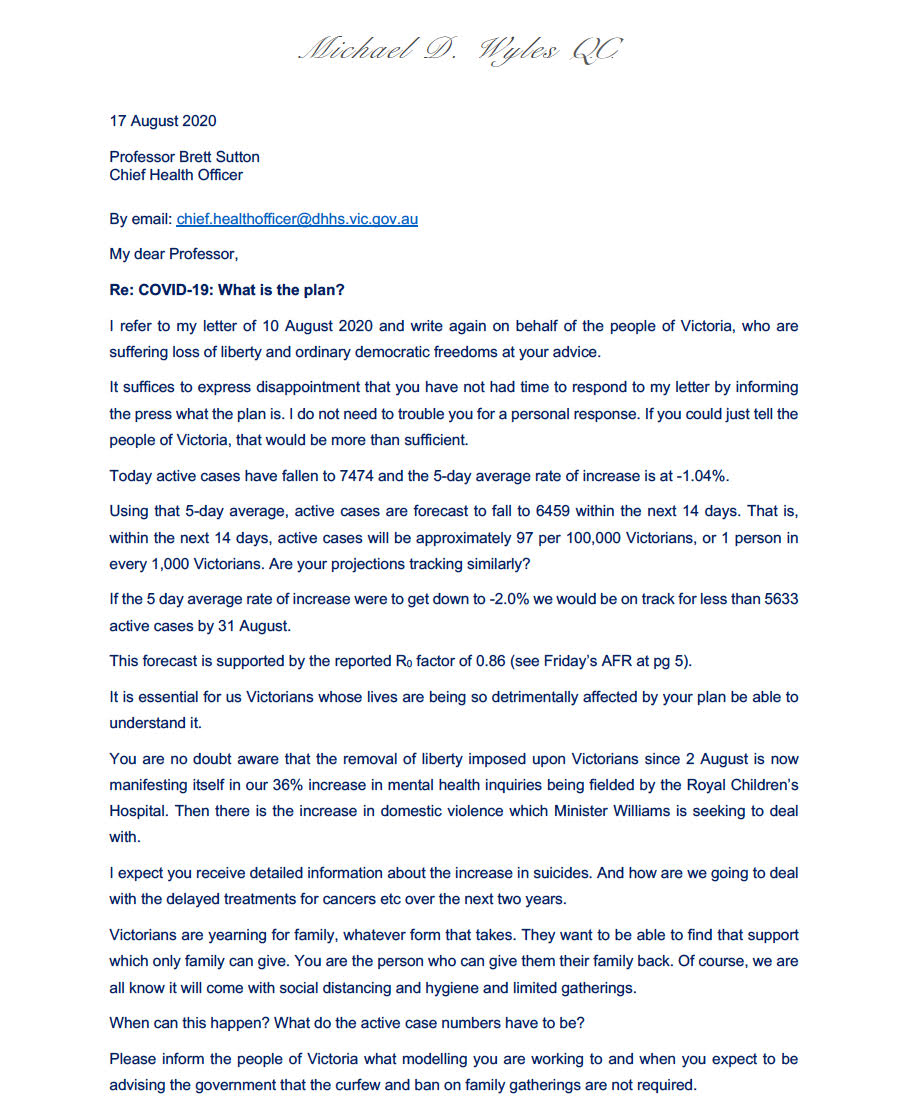
“On behalf of the people of Victoria,” he wrote a week or so ago to Professor Brett Sutton, Victoria’s Chief Health Officer, complaining that he had not received a reply to an earlier letter.
He wants to know what modelling is guiding the CHO’s decisions and when he can advise the government to lift the curfew and the ban on family gatherings.
The state of emergency is too much, what with mental health problems, suicides and domestic violence.
“You are the person who can give [Victorians] their family back,” he advised Prof Sutton.
This followed a letter he sent to Scott Morrison on July 9, begging the prime minister for help:
“Our quality of life has been decimated by the lockdown. The mental strain of another six weeks being imprisoned in our homes, watching our fellow Australians enjoying meals out, good times with friends and new work opportunities, is just too much to contemplate. How do we keep the black dog in his kennel?”
“The problem is that Sutton keeps referring to community transmission as a problem. But if it is stopping his advice that we be released from this absurd police state, we need to understand it accurately.”
He thinks the community transmission figures have “all the hallmarks of being inflated and driven by ‘confirmatory bias’.”
Wyles QC FAICD reassuringly says that he would “not wish a cytokine storm on anybody”.
The Monday to Friday bulletins from Wyles HQ analyse the stats in granular detail. On August 25 he said that Victoria is down to 3,731 active cases, of which 42% are in aged care (1,568) and a further 13% (476) in health care.
“So the active cases throughout the broader community are 1,687. That is 25 persons in every 100,000 or about one person in every 3850 people you come into contact with.”
As for the number of deaths – don’t be alarmed. The most recent mortalities were all in aged care. He advised that as at August 24, “Outside of aged care we had only 135 Covid-19 deaths. It has not in any sense caused, nor does it threaten to cause, widespread death”.
Phew. It’s all too minuscule a problem to worry about, which is in step with the thesis propounded by the learned fellows and scholars at the IPA – “the voice of freedom”.
Liberty Victoria also opposes a 12 months extension to the state of emergency, instead suggesting a six months extension with four-weekly reviews to “ensure that limits on human rights and freedoms will only continue where necessary”.
Justinian can remember that things were worse between the early 540s and the middle the eighth century.
It’s worth getting Wyles’ Covid-19 missives for the sheer beauty of his graphs. Behold, here is the offering for Tuesday (Aug. 25) …
And a global perspective sent from Aickin Chambers on August 19 …

It’s good news for Sydney solicitor Myroslava Zhukovska after the NSW Court of Appeal decided that she will remain on the jam roll, despite overcharging an elderly client, giving herself improperly wide trustee powers and making risky loans out of an estate.
A bench made up of Robert Macfarlan, Mark Leeming and Lucy McCallum confirmed the lawyer’s ticket would be cancelled for now, but left open the possibility Zhukovska could ply the trade once more – if she proved herself fit and proper.
Myroslava’s professional problems date back to 2013 and 2014, when she was in her first two years as a sole practitioner at Neutral Bay and Dee Why law shop McMahon Todd.
After upping sticks to the Emerald City, she undertook a legal bridging course – this time in English.
Soon after she joined McMahon Todd, Zhukovska encountered an elderly woman, Dulci Barbara Heane, who found herself in an age care facility.
Heane gave Zhukovska powers of attorney, so that the lawyer could arrange for the renovation of a Collaroy apartment, consolidate bank accounts and make investments on her behalf.
Zhukovska advised that her fees would be between $12,280 and $21,650. But after five months’ work, the bill came to in excess of $76,000.
Zhukovska’s own hourly rate was $310 while junior lawyers also billed big, including for work like supervising tradespeople at Ms Heane’s apartment. This conduct was “disgraceful and dishonourable”, NCAT found.
Zhukovska also set up a trust over Heane’s estate, with herself as trustee. In NCAT’s view, the trust fund was unnecessary, given the small size of the estate. Further, it was professional misconduct for the Russkie to give herself wide, discretionary trust powers.
After the sale of Heane’s Collaroy unit, Zhukovska began making unsecured loans from the proceeds – including to her own firm. NCAT found the solicitor did not have instructions and risked her client’s interests.
Even though there was an array of professional misconduct and unsatisfactory conduct findings, NCAT stopped short of striking off the solicitor.
The tribunal pointed to a number of character references and noted that there was no allegation of dishonesty in Zhukovska’s misdeeds.
The conduct was serious and showed Myroslava was currently unfit to practise, yet it did not show she was permanently unfit.
Cancellation of her ticket was enough, and she would be at liberty to reapply after 12 months.
 The Law Society appealed this decision, arguing Zhukovska should have been stricken.
The society’s main thrust was that the tribunal had failed to specify when or in what circumstances the solicitor would become fit to practise again. That meant the “only option” was to declare Zhukovska permanently unfit and to strike her off.
Leeming JA, delivering judgment for the court, rejected this argument. He said the onus remained with the Law Society to prove the lawyer was permanently unfit.
It was correct for NCAT to cancel Zhukovska’s practising certificate if it believed she would become fit again, but did not know when.
Further, HH agreed that Zhukovska, despite being presently unfit, would possibly become fit in future.
Leeming ruminated on her “struggles” to qualify as a lawyer, saying she was “enterprising, diligent and self-motivating”.
“There is every reason to think that she might be able to become fit to practise,” he concluded.
Yet, the tribunal was wrong in one respect. It had failed to impose conditions on Zhukovska’s future as a lawyer, except for a 12-month ban.
There was no basis for concluding, HH said, that Zhukovska would become fit for practice simply because of a year-long wait.
Leeming therefore ordered that the parties make further submissions on what conditions the ticketless respondent should have to meet before she can reapply for a PC.
He envisioned those conditions might be an 18-month ban, time in a re-education camp and a period in which she could not practise as a principal or act as a trustee.
His Honour left undisturbed the tribunal’s costs-order, which was for Zhukovska to foot the law society’s bill.
Whatever would Frank Hutley say?