









There’s a steady drum roll as we head towards May 17 and the 200th birthday of the NSW Supreme Court.
The prelude is a dizzy round of briefings, book launches, banquets, prayers, theatrical events, and historical reminiscences.
Reptiles of the press were summonsed last month to appear before Chief Justice Andrew Bell for a briefing on the forthcoming festivities.
He recognised the danger posed by a “trust deficit” in judicial institutions, with an oblique reference to the US Supreme Court and whether it can be trusted in Trump related cases.
The birthday celebrations also have a public purpose – to remind as many who are not completely comatose that the longevity of the Supreme Court reflects the trust people have in it.
Bell also referred to the form of some of his predecessors, including John Kerr who, apparently, wasn’t all bad because he saved the magnificent heritage court buildings from the wrecker’s ball.
The space outside the Banco Court is adorned with portraits of notable female judges: Margaret Beazley, Jane Mathews, Virginia Bell, Paddy Bergin, and Caroline Simpson.
There’s also a wall with the faces of former chief justices whose eyes follow us around the room; and just around the corner a history gallery – displaying great and meaningful criminal and civil moments in the life of the court.
Following recommendations of the Bigge report, the UK parliament passed the New South Wales Act (1823) creating the Legislative Council and the Supreme Court, which also held sway over New Zealand and Tahiti – at least in relation to crimes committed by British subjects.
The first chief justice was Francis Forbes, previously Chief Justice of Newfoundland. He had helped draft the NSW Act and the Third Charter of Justice, which replaced the legal tribunals and the Supreme Court of Civil Judicature.
The charter was “the instrument that redeemed the colony of New South Wales from its earlier destiny as a mere oubliette for felons”.
The original title for the NSW CJ was “Supreme Judge of the Supreme Court”. Bell CJ mentioned that he was interested in seeing if this could be revived.
Forbes was a refreshing figure, a supporter of press freedoms and free education, and a relief from several of the previous appalling judicial office holders – including the unfortunately named Judge Bent – who was the first Australian judge to be removed from office.
The colonial powers kept moving him on, rather like Catholic Archbishops shifting bad priests. Bent became CJ of Grenada (twice suspended), St Lucia, and British Guiana (where he died).
Smiler Gleeson wrote of Bent:
“He is generally regarded, not only as the first judge in New South Wales, but also as the worst. The one thing he had to recommend him was a spirit of independence. He gave an early display of his mettle upon his arrival in Sydney, by refusing to disembark from his ship until the Governor arranged for a proper battery of guns to salute him.”
He was replaced by Barron Field, another pre-Supreme Court judicial identity, a descendant of Oliver Cromwell, who spent a great deal of his time writing execrable poetry:
Kangaroo, Kangaroo!
Thou Spirit of Australia,
That redeems from utter failure,
From perfect desolation,
And warrants the creation
Of this fifth part of the Earth,
Which would seem an after-birth,
Not conceiv”d in the Beginning
(For GOD bless”d His work at first,
And saw that it was good),
But emerg”d at the first sinning,
When the ground was therefore curst; –
And hence this barren wood!
And so on.
He was the author of the first (slender) book of verse to be published in Australia. Later he was shuffled to Ceylon and then a judicial appointment in Gibraltar.
For almost a century there were no Catholic judges on the Supreme Court of NSW, just as there were no women. Now more than two-thirds of legal practitioners under the age of 35 in NSW are female, as are almost 45% of the state’s judicial officers.
For the Local Court 50% are female magistrates, the District Court about 40%, the Land & Environment Court has four out of six, and the Supreme Court 15 out of 51 (30%). God knows how many are Catholic.
Last week (April 3) Spiggsy Spigelman returned to his old Spiegeltent to launch Constant Guardian. This is not a pharmaceutical product for incontinence, but a revelatory book on the history of the court.
YouTube has a video of the event …
It’s edited by Keith Mason, former president of the Court of Appeal, and the splendid Larissa Reid from the Law Courts Library. There are 17 chapters including the lives of judges, famous criminal cases, empire and war, and Indigenous people.
Justice Peter Applegarth from the Queensland Supreme Court gave an endorsement:
“This impressive work reveals the eccentricities of some judges, and it reports and explains the history of an institution that is critical to democracy and the rule of law. It is engaging. It tells many great short stories. These prove that ‘colourful Sydney identities’ are not confined to racetracks. Many have visited the Supreme Court of New South Wales, and, for over 200 years, some have graced its Bench.”
It’s a snip at $75 and for another $680 Simon Fieldhouse’s sketches of the current judges are available.
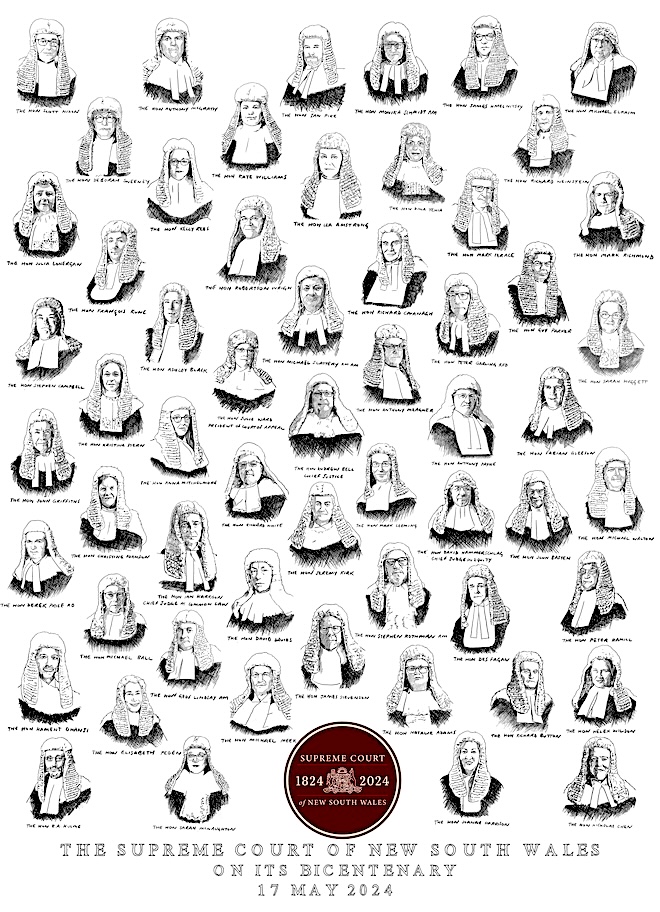
On Damien Carrick’s Law Report Chief Justice Bell spoke about the book and associated anniversary knees-up.
Other planned events include a two-night production of Gilbert & Sullivan’s Trial by Jury, directed by Vicki Hartsteinwith Ros Croucher from the Human Rights Commission playing the judge and the performance conducted by Peter Hidden. (May 30 and 31, Banco Court, tickets $40.)
Chief justices from around the Wide Brown Land and New Zealand are flying in for an “all faith” church service at St James and for the big ceremonial beano at the Banco Court followed by a well-catered lunch. It’s May 17, feast day of Saint Pascal, patron and protector of congresses and associations.