



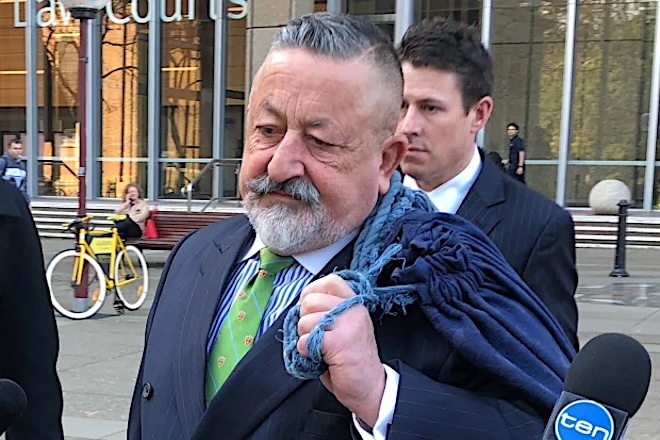
Jack Pappas – defence warhorse
The criminal case against former University of New England vice-chancellor Brigid Heywood will be reheard, after the NSW Supremes barred Magistrate Mark Richardson from deciding the matter on account of eruptions during the hearing and apprehended bias.
The case concerned Heywood’s conduct at a Women’s Day event in 2022, where she allegedly licked her finger, wiped it on a schoolgirl’s face and made racist remarks. She pleaded not guilty to charges of common assault and behaving in an offensive manner in public.
Heywood had been an academic specialising in inorganic materials chemistry at various universities in the UK.
In 2013 Justinian had the unhappy duty to report disquiet at the University of New England, in the era when Eddie Obeid’s chum and struck-off National Party candidate Richard Torbay was the university’s chancellor.
Justice Julia Lonergan in the NSW Supremes ejected Richardson from hearing Police v Heywood owing “push and shove” disagreements with defence barrister, Jack Pappas, which spiralled into animosity and the “shocking” threat to have Pappas ejected from the courtroom.
Madge Richo was famous in his previous career as CEO of the Law Society of NSW for ten years – during which he weathered plots, rebellions and attempts to defenestrate him onto the Phillip Street footpath.
Court transcripts in the police case against Heywood recorded how disagreements about Pappas’ style of cross examination devolved into bickering and sparring. The following exchange took place after Pappas expressed frustration at the objections of the opposing police prosecutor, Sergeant Smith:
PAPPAS: I’m not here doing my first hearing in a Magistrates Court, and it is not helpful to have the Sergeant interrupt that cross examination which is absolutely according to Hoyle.
HIS HONOUR: That is what happens in a Magistrates Court, it’s what’s happened in this Court ever since I’ve been a Magistrate. Just proceed, Mr Pappas.
PAPPAS: Well, then perhaps it shouldn’t be happening, your Honour.
HIS HONOUR: Don’t waste my time.
PAPPAS: I’m not wasting your Honour’s time, I’m –
HIS HONOUR: Yes, you are. Proceed.
Jack Pappas was recently mentioned in dispatches by The Australian’s Janet Albrechtsen, during her recent tirade against Lucy McCallum, chief justice of the ACT Supreme Court.
In an interview with the Canberra Times in May this year McCallum CJ talked about the need for a better balance between conducting a fair trial and testing the evidence form sexual assault complainants.
Planet Janet erupted in a spume flecked outburst that took McCallum’s remarks out of context.
“Judges should stick to their day job, behind the bench, overseeing trials rather than giving the impression that they would rather be law reformers.”
Pappas was reported to drafting a lengthy and fearless letter in response to McCallum’s interview. He said that while everyone endorsed what he was saying, “almost to a man and a woman they’ve shied away from putting their name to it”.
Though Lonergan J found that the “apparently inexperienced” Sergeant’s objections were “overzealous” at times, she also felt Pappas was “unduly personal and insulting” towards the prosecution.
Despite this, she felt that the Magistrate’s attempts to maintain the propriety of the court took an impermissible “descent towards insult”.
HIS HONOUR: Just move on and ask the question in a way in which she [the witness] can answer.
PAPPAS: No, I will not be bullied and moved on. Your Honour.
HIS HONOUR: Ask the question in a way this witness can answer it.
PAPPAS: Your Honour is making this an impossible task by your Honour’s constant interaction with me in this fashion.
HIS HONOUR: With respect, Mr Pappas, it’s you that is making it a difficult task.
As hearings continued, the Magistrate’s tone sifted from “maintaining control of the Court … to being overtly critical of counsel.”
The following exchange took place after Pappas questioned the disturbed nature of the proceedings:
PAPPAS: We’ve now got to the point where this has gone on and on and on.
HIS HONOUR: That’s quite so, sir. I agree. It’s going on and on and on.
PAPPAS: Yes. I know what your Honour means by that, that –
HIS HONOUR: Which is exactly how it has been. Yes.
PAPPAS: – the subtext is, ‘Yes. Mr Pappas, it’s you that’s dragging it on and on and on’.
HIS HONOUR: It’s quite possible.
PAPPAS: That’s what your Honour is saying to me.
HIS HONOUR: It’s quite possible.
PAPPAS: I’m not ignorant of your Honour’s inference.
HIS HONOUR: It’s quite possible.
PAPPAS: Your Honour’s animosity towards me is palpable.
HIS HONOUR: I have no animosity towards you.
PAPPAS: Your Honour clearly does.
HIS HONOUR: Come on.
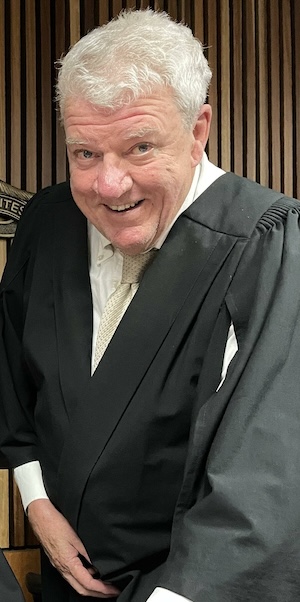
Mark Richardson: animusWhile Justice Lonergan recognised that Pappas took a “stentorious and lecturing” manner in the proceedings, she found that Richardson “crossed the line” while attempting to control Pappas’ manner of questioning:
HIS HONOUR: Can you remember the question, Mr Pappas, this time?
PAPPAS: Yes, I can, your Honour.
HIS HONOUR: Well, ask it again.
PAPPAS: There is absolutely no need for your Honour to be rude to me.
HIS HONOUR: I’m not being rude to you.
PAPPAS: Your Honour is being gratuitously rude.
[snip]
HIS HONOUR: I’m not being gratuitously rude. I just asked you to remember what the question is so that we can debate whether it’s a valid question or not.
PAPPAS: Yes.
HIS HONOUR: Move on.
PAPPAS: Now your Honour is raising your voice and shouting at me.
HIS HONOUR: I’m not being – I’m just asking you to move on.
PAPPAS: Your Honour is shouting at me.
HIS HONOUR: I apologise, Mr Pappas but I am probably going to warn you … unless you pull this together. First warning. Proceed.
PAPPAS: Sorry, I don’t understand a first warning.
HIS HONOUR: I think you’re getting very close to being in breach of that Evidence Act provision that precludes you asking questions that are harassing and intimidatory in nature […] Mr Pappas. Proceed.
PAPPAS: Your Honour, there is –
HIS HONOUR: Proceed or I’ll ask you to be removed from the Court. Proceed.”
While the defence argued that the two were engaging in “robust debate” that was not uncommon in the LC, HH found that the suggestion that Pappas should be removed was “unambiguous and humiliating”.
Applying the “two mights” test of apprehended bias, Lonergan J concluded that the magistrate’s deteriorating cool and “animus, contempt and disdain” could lead a fair-minded observer to conclude that he might be biased towards Pappas.
Despite this, HH stated that she was disqualifying Madge Richardson “reluctantly,” citing the fact that Pappas was at times “offensive, supercilious and unprofessional” (not to mention “truculent”) during the hearings, especially towards an opposing counsel of “apparently less experience”.
The Supreme Court ordered that Magistrate Richardson be prohibited from further hearing the matter.