


Michael Bryan Joshua Lee and Robert James Lee Hawke (AFP)
The bones of Michael Lee’s judgment are being picked over as we speak. Some earnest types complain that he must be a show-off as he littered the text with so many attention grabbing bon mots, literary flourishes and cultural references.
But, here at Justinian, we think Lee J’s frolic with language is just what is required to leaven the stodge that flows like cold porridge through most judicial thoughts.
We’ve selected some of the best, which give as good an insight into the nature of the judge himself as you’d get if Liam Bartlett interviewed him on Spotlight.
152: “But irrespective of legal obligation, there are gradations of the seriousness of untruths: an untruthful person may just be all mouth and trousers; or be recklessly indifferent to the truth …”
The alternate expression is “all mouth and no trousers”: Talking about doing something and never actually doing it. Braggadocios. The Texas version is “All hat and no cattle.” Origins obscure.
169: “… the evidence of Mr Auerbach travelled beyond seeking to impeach the credit of Mr Lehrmann. He laid the allegations on thick against a variety of persons – somewhat like the paint in an early work of his namesake, Frank.”
Frank Auerbach, the British-German painter, was sent from Germany to London during the war under the Kindertransport scheme, which brought Jewish children to the UK to escape the Nazis.
David Bowie bought Head of Gerda Boehm, a painting of the older cousin of Frank’s and after Bowie’s death it was offered for auction at Sotherby’s with a price estimate between £2-3 million.
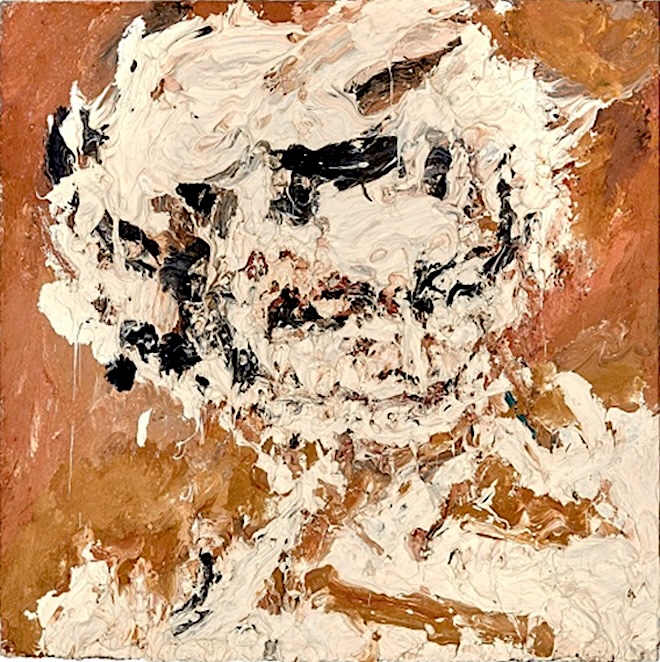
Frank’s Auntie Gerda
200: “As to the book, as the saying goes, an autobiography usually reveals nothing bad about its writer except his memory.”
This relates to Penguin Random House’s book deal with Brittany Higgins. The draft was tendered into evidence and HH made this pithy aphorism when discussing points made in submissions by Lehrmann on Higgins’ credit, where Higgins herself described the book as “crap”.
The quote about autobiographies is attributed to the American writer and humorist, Franklin P. Jones.
383: “Nick, alas, was left chatting to a man in a blue shirt. After being forsaken like a shag on a rock for an extended period and despite then making successful attempts to interact with some of the group on the larger table, Nick understandably left The Dock, no doubt ruing swiping right.”
Nick was the “Bumble guy” Higgins was supposed to hook up with at the Dock, instead she fell in with Lehrmann and his crowd and ended up being raped.
“Shag” is the Australian bird, famous for sitting alone, and probably an unfortunate word to use in the circumstances of the case.
According to Lee’s carefully constructed table of alcohol consumption [395], Nick bought Higgins two spirit based drinks at The Dock on March 22, 2019.
428: “Nothing good happens after two o’clock in the morning … drink and the wee hours often occasions trouble.”
Justice Lee was quoting himself in the opening lines of a defamation judgment he delivered in April 2019, Oliver v Nine Network Australia.
516: “Mr Lehrmann said he was going to show Ms Higgins whisky – not Qing Dynasty ceramics.”
HH intuitively thought the drinking would have continued when Lehrmann and Higgins went back to Parliament House. The parliamentary objet d’art collection does not run to ceramics from this era.
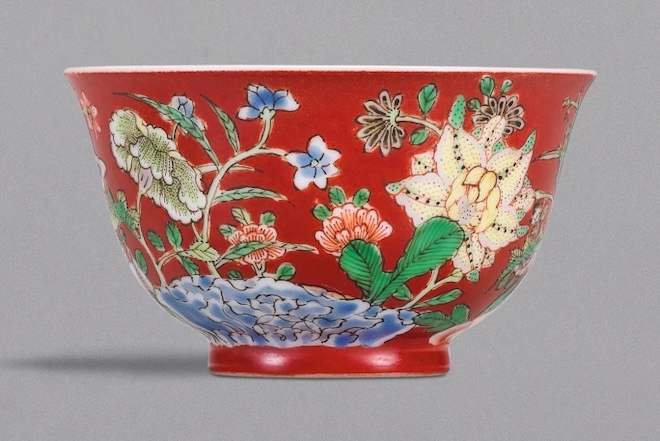
A Qing-era floral cup (not on display in Sen. Reynolds’ office)
598: HH found that Lehrmann was indifferent to whether Ms Higgins consented or not, “and he just went ahead willy-nilly“.
This came from a passage in the judgment dealing with “non-advertent recklessness”. The High Court also used “willy-nilly” in an earlier sexual assault case, Gillard v The Queen, and in turn that was drawn from Lord Cross in a House of Lords decision, DPP v Morgan – an extraordinary case in which a husband was accused of aiding and abetting the rape of his wife by three other men.
Judicial use of the word “willy” in rape cases is not ideal.
1091: Under the heading Conclusion and Orders, HH made his by now famous quip: “Having escaped the lions’ den, Mr Lehrmann made the mistake of going back for his hat.”
This is a favourite of judges who feel the need to spritz-up judgments or exchanges with counsel. Former High Court Justice Kenneth Hayne used it frequently as a warning to barristers.
It’s a saying that originated in Somalia – apparently. Justin Quill, the external litigation solicitor for Network Ten claims he used it in relation to Lehrmann on Media Watch in 2022: “Lehrmann bringing this case would be a man going back into the lion’s den to retrieve his hat.”
It was so good he used it again in December 2022 on the ABC. It looks as though Lee might have borrowed the quip from Quill and now the solicitor has attracted the Lee’s attention with his post-judgment criticism of aspects relating to the reasonableness of the journalists’ conduct.
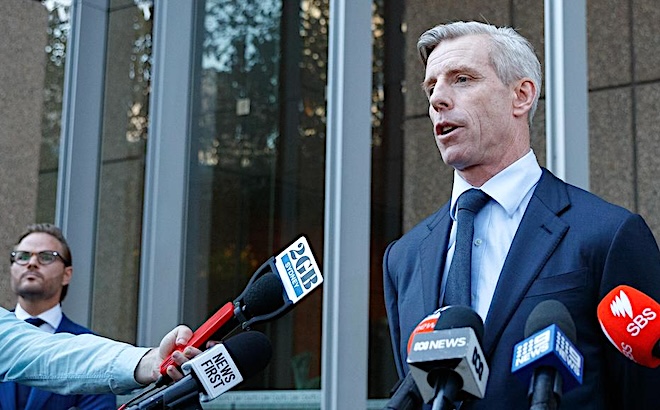
Justin Quill: Lee has asked for a transcript of his remarks
The Financial Review reports that Barry Humphries used the phrase about the lion and the hat on 60 Minutes in relation to his decision never again to touch alcohol.
Fortunately, one of the favourites trotted out by Justice Lee about the “Tigris and Euphrates of the truth defence” didn’t get a fresh run in the judgment.
He used it in an earlier judgment dealing with cross-examination in the Lehrmann case and again we found the two rivers flowing through his reasons in ASIC v GetSwift Ltd, which he described as a “Daedalian maze”.
2: Justice Lee opened his reasons by describing the detours and collateral damage flowing from the case as an “omnishambles“.
The word is described as “a neologism first used in the BBC political satire The Thick of It (2009)” – created by Armando Iannucci and starring Peter Capaldi.
It soon gathered popularity and in 2012 the Oxford English Dictionary declared it Word of the Year.
≈ ≈ ≈
There are other quaintnesses littered throughout the text of the judgment …
616: “It is passing strange …” Judges like these sort of flourishes. It’s the sort of thing George Brandis or David Flint would say as they add a few curlicues to their pronouncements. Apparently, it has more gravitas than simply saying, “it is strange …”
1072: Lee said that Lehrmann behaved like a “blackguard” to his girlfriend who was waiting at home while he raped Brittany Higgins and then left Higgins half-naked on the minister’s couch.
The word is from the early sixteenth century and refers to attendants or people in menial jobs, especially those in charge of kitchen utensils.
573: “Cad.” Another of Lee’s archaisms. “… getting out of the ministerial office with celerity (and leaving Ms Higgins undressed) is the action of a cad …”
1097: The idea that there had been an attempted political cover-up of the rape “caused a brume of confusion”.
You have to go back to the late 15th century for the derivation of “mist or fog”.
77: “… it is plain as a pikestaff” that Lehrmann was identified in The Project broadcast on ten.
The judge quite likes that one. He and Justice Nye Perram used it before and as a senior counsel Mr M.B.J. Lee SC made sure it was deployed in submissions before Justice Duncan Kerr.
We also got “preternatural” [17], “irrefragably” [256] and “druthers” [517].
There’s no shortage of long forgotten lingo fed into the magnum opus, a device frequently deployed by judges to bring a greater lustre to their work.
The other more contemporary cultural, historical and political references also flowed thick and fast with mentions of Mamma Mia [397] and Back to the Future [405] – mentioned by the judge in relation to an explanation for the name of the Canberra watering hole 88mph:
“… no evidence was adduced as to why the bar had this name, but one might speculate the owner was an aficionado of the popular 1985 film Back to the Future where Marty McFly (Michael J Fox) travels in a DeLorean time machine from the 1950s back to the 1980s at that speed.”
At [158] the judge mentioned that the CCTV footage from The Dock would be examined with “the same intensity that others analyse the Zapruda film”.
At [749] he quoted the Nixon era aid H.R Halderman who said: “once the toothpaste is out of the tube, it is awfully hard to get it back in.”
And a judgment of this soaring reach would not be complete without an appearance of Mandy Rice-Davies and the trial of Stephen Ward arising from the Profumo Affair. See [959].
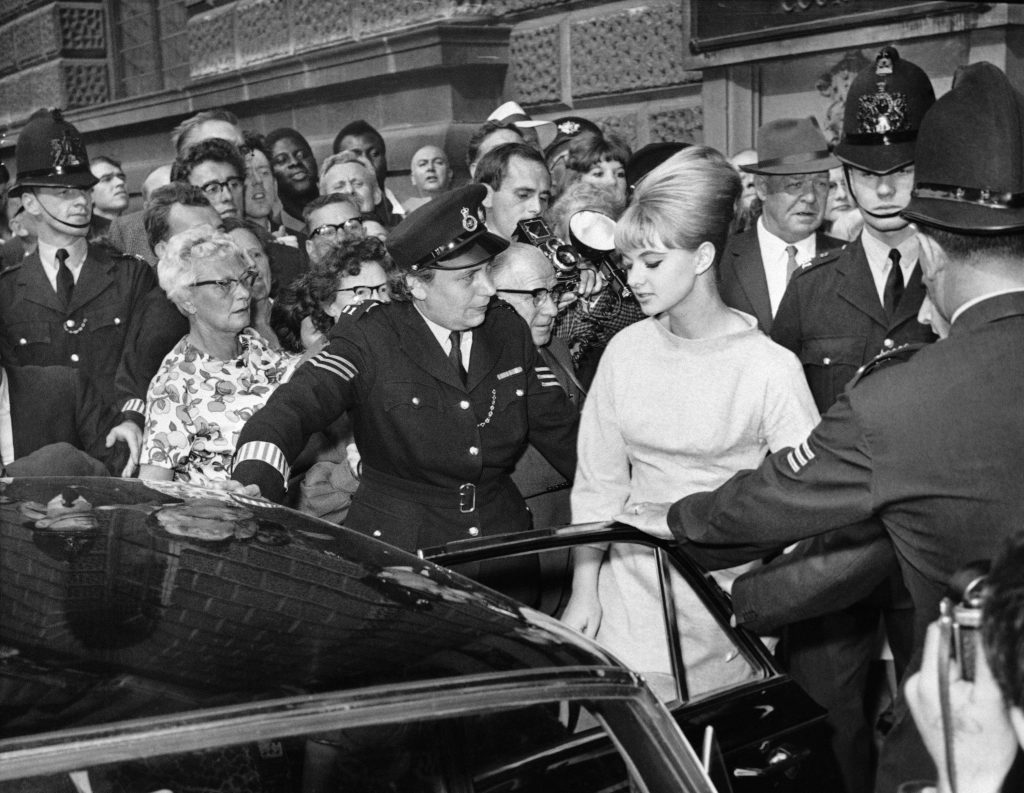
Rice-Davies: “Well he would, wouldn’t he?”
Lee also turned to numerous learned works, including: Maimonides, The Commandments (1967), and Voltaire, Zadig; or, The Book of Fate: An Oriental History (1749), plus numerous texts on rape victims and the “tonic immunity response”.
This is only to be expected from someone with an understanding of human behaviour and a kaleidoscopic knowledge.