
The connection between my medical appointments, Robodebt and the British Post Office scandal may seem elusive but bear with me dear reader (the editor claims there is one).
Advanced decrepitude requires that I see a specialist every three months.
Six weeks after the last appointment I received an admonitory email demanding that I make a booking. I fired back: due every thirteen weeks, not six.
A fortnight later, another email rattled the cage. So I phoned up to be told that the specialist’s diary wasn’t yet available. I’d have to wait.
Why I was receiving demanding emails if no one was in a position to take a booking? The answer was, of course, “nothing to do with me, mate”.
A few weeks later, a threatening email. We’ve had it with you. If you don’t make a booking, we’ll report you to your GP for declining treatment.
The diary was still not available, so no booking could be made – the best they could do was disconnect me from the automated call-up system.
And therein lay the problem: rudimentary AI was set up to do the contacting to call for bookings, and programmed to go its hardest, without any reflection on individual cases or circumstances.
All of which rang the Robodebt bell – but, even earlier and chiming longer, was the Post Office scandal in the UK.
Both involved automated computer driven systems for oversight of those dependent on or associated with government. The systems had the power to pursue those deemed to be at variance with accounting standards. All this without any human intervention on the side of the pursuing Furies.

Furies in pursuit
Allowing for political passion in the delivery, here’s a summary from Attorney General Mark Dreyfus in The Monthly, February 2024, on the end product of Robodebt, as determined by the Royal Commission:
“Mr Dutton continues to assert that ‘when the problems were brought to the attention of the government at the time, the program was stopped’. The royal commission found that the opposite was true: in early 2017, when ‘Robodebt’s unfairness, probable illegality and cruelty became apparent’, the path taken by the former government ‘was to double down, to go on the attack in the media against those who complained and to maintain the falsehood that in fact the system had not changed at all’.
It was not until mid-2020 that the Robodebt scheme finally came to an end. Not because the former government stopped it voluntarily, but because the Federal Court forced it to be stopped by finding the scheme unlawful.”
Meanwhile in the UK, where a long history of government control of the mail service through the Postmaster General had terminated with privatisation, the now owners, Post Office Limited, instituted a computerised accounting surveillance system over their sub-post offices (branches in retail stores). The system was developed by Fujitsu and called Horizon.
From late last century Horizon began reporting on defalcations by sub-post masters (SPMs), and the reports led to over 700 prosecutions and nearly 200 prison sentences, reputations trashed, court orders for reimbursements (of money not actually missing, let alone stolen) to the tune of thousands of pounds per affected SPM, and as with Robodebt suicides of those deemed by the machine to be guilty.
As became apparent from the resulting blowback, not only was Horizon faulty in its assessments, but the prosecutions were mounted with no evidence compiled by natural persons, and entirely dependent on the “evidence” manufactured by Horizon.
As protests emerged as to the soundness of the convictions, reports were written analysing the deficiencies of Horizon. As with Robodebt, the reports were ignored and buried.

Holroyde: POL knewIn Ambrose v Post Office Limited[2021] EWCA Crim 1443 (well down a chain of appeals cases quashing Horizon based convictions), Holroyde LJ for the court said:
“… we were satisfied that throughout the relevant period there were significant problems with Horizon, which gave rise to a material risk that an apparent shortfall in the accounts of a branch post office did not in fact reflect missing cash or stock, but was caused by one of the bugs, errors or defects which … existed in Horizon.
We also concluded that during the relevant period POL knew that there were serious issues about the reliability of Horizon; had a clear duty to investigate all reasonable lines of enquiry, to consider disclosure and to make disclosure to the appellants of anything which might reasonably be considered to undermine its case; but failed adequately to consider or to make relevant disclosure of problems with or concerns about Horizon, and instead asserted that Horizon was robust and reliable.
We referred to the advice given to POL in 2013 by a barrister, Mr Simon Clarke, in relation to its duty of disclosure. We were satisfied that POL had consistently failed to be open and honest about the issues affecting Horizon and … had effectively steamrolled over any SPM who sought to challenge its accuracy.”
Ambrose involved convictions against many Horizon victims being quashed, and that case built on many before it.
The same year, 2021, Paul Scully junior Business Minister in the British government said, as a statutory public enquiry was launched:
“The Horizon saga has wrecked lives and livelihoods. We can’t undo the damage that has been done. But we can establish what went wrong with the Post Office and ensure something like this is never allowed to happen again.”
Since announcing a statutory enquiry, the British government has signed a new contract with Fujitsu for £142 million for further computer services. Not so much the Australian cover up from inside government, as merely business as usual.
What did resemble the Australian pattern was that the head of POL, Angela van den Bogerd, lied publicly about Horizon after being made aware of its deficiencies, while bullying all those within her reach.
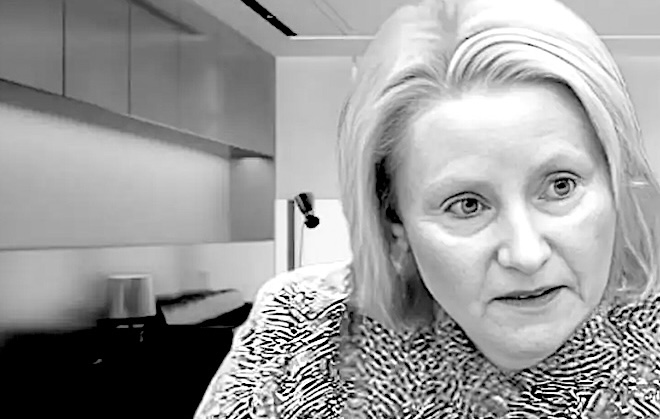
van den Bogerd: bullying postmistress
In the lead case involving the vindication of the SPMs, Bates v Post Office Ltd (No. 3)[2019] EWHC 606 (QB) (the Bates cases stretch out to No 6), Fraser J found (at [417] that van den Bogerd had “obfuscated” and “misled” the court.
One victim SPM, Mrs O’Dell, said Ms van den Bogerd, “became extremely intimidating, extremely bullying … demanding that I sign a piece of paper that I had stolen the money … and if I did not they were going to take my home away. They would take me to court.”
The television drama based in the litigation is about to be released in Australia.
At least in Australia, the quasi-judicial arm of government, the AAT, drew conclusions against the acceptance of Robodebt generated claims within two years of its inception: see the work of Prof Terry Carney as an AAT member. He was of course duly not reappointed.
In England the judiciary began from a stand point of acceptance that Horizon’s accounting was not to be questioned: see R v Castleton[2007] EWHC 5 (QB).
An English expert accountant, James Christie, has attacked as “absurd” the presumption in English law that computers operate correctly.
“The question of reliability is essentially one of control, and we can never be certain that we are in full control of complex software”.
See: The Post Office Horizon IT scandal and the presumption of the dependability of computer evidence (2020) 17 Digital Evidence and Electronic Signature Law Review 49-50.

Carney: ruled against the Robodebt scheme five times
In Pintarich v DCT(2018) 262 FCR 41 the Full Federal Court split over the acceptance of computer driven decision-making. Kerr J alone worrying over the need for human mental input into government decisions affecting people.
Terry Carney, reinstalled in academia after his defenestration from the AAT, has written extensively (and been cited in the Robodebt Royal Commission) on this conundrum: how is the necessary presence of human involvement in decision making to be assessed?
AI is now on us, and the omens that we are prepared for the social revolution it brings are not good. Of course, the Great and the Good murmur about how much money they’ll save if humans are made redundant on government overview processes.
The cost so far to welfare recipients in Australia and the struggling underclass that work as sub-post masters in UK has been catastrophic – restricted to those travelling steerage.
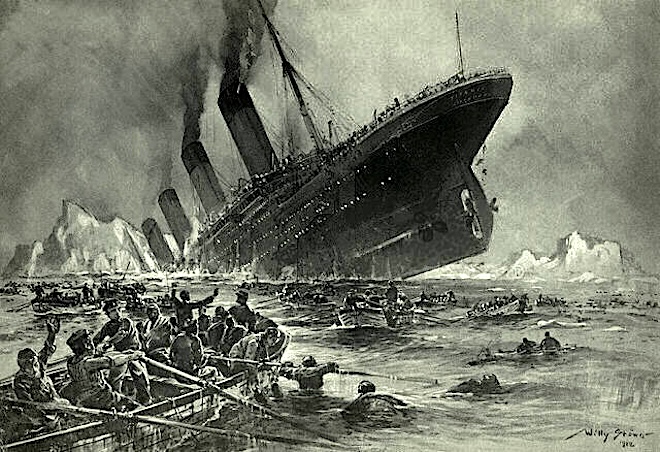
Catastrophe for those travelling steerage
Social costs are now borne on an even starker basis than they were as the Titanic sank: no male plutocrats are going down thus far.