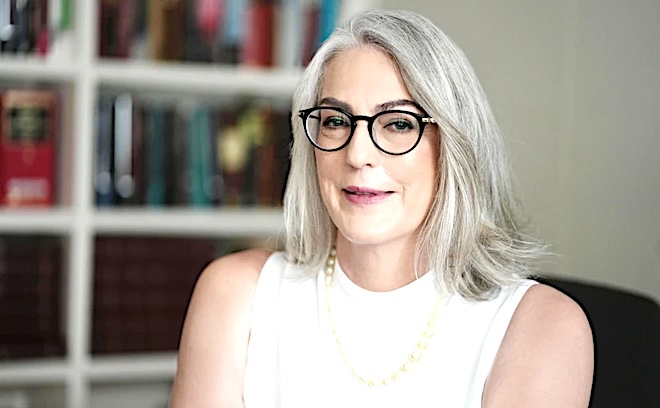
Jane Needham: ancient lineage
Two new Federales being commissioned in the first week of July: Jane Needham SC to the NSW Registry, and Stephen McDonald SC to the boutique South Australian branch.
See: AG’s announcement
Needham J hardly needs introduction, having been President of the NSW Bar Association, and with judicial ancestry rather predating her father’s time on the NSW Supremes (one of the finest and kindest of equity judges, according to Smiler Gleeson in a farewell), going back to Sir John Needham in Common Pleas from 1457.
Some have speculated that her artfulness in equity would have been better exploited on the NSW bench, but the Feds have their equitable moments, and her Honour’s wiliness in administrative law will be of huge benefit.
Stephen McDonald SC will be less well known on the East Coast, but at 44 was the coming silk in SA. His background was State Crown Law where he was close to Chris Kourakis, who was solicitor general at the time.
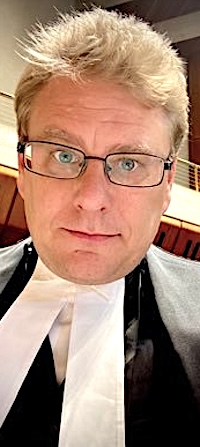
Then to Hanson Chambers, and silk. Adroit in turning arguments on the fly, he was building a High Court practice, which will now be turned to disgruntled litigants taking his decisions up.
McDonald: intense speculationStephen’s genial disposition will be well suited to the bench, but be careful if you see him in his red MG – his one vice.
Since the Federal Court is so obviously a breeding ground for those who make the Last Chance Saloon, any new appointments in South Australia to the three judge Registry are treated to intense speculation: could a newly minted judge have what it takes?
The classic lament in Adelaide involves a lack of any South Australian appointment to the High, a fate shared with Tasmania, although they now claim at least a half share in Beech-Jones J, for his formative years on the Map’s west coast.
And the record is clear that Andrew Inglis Clark, Founding Father and Tassie Supremo was to be offered a place on the High, until premature death intervened in 1907, when he was only 59.
Crow Eaters might take note that their kind have not all been ignored by the powers that be. Sammy Way, CJSA from 1876 to 1916 was offered a place on the High, which elicited the response:
“I should rather remain Chief in my own jurisdiction than become a subordinate member of an itinerant tribunal.”
Oh well, Caesar said:
“I would rather be chief of the meanest Helvetian village than second in Rome.”
And Way was then looking at a picture of judicial power vastly different a century later. The High in 1907 at the time of offer was substantially subordinate to the Privy Council, and having no central registry or building of its own, was reduced to traipsing around the huge continent in an interminable circuit worthy of Sisyphus.
Way really made his point by taking himself off to London, and on the basis of his title as “The Right Honourable” i.e. made a member of His Majesty’s Privy Council, he sat uninvited on a week of Privy Council cases.
What their Lordships made of that is not recorded.
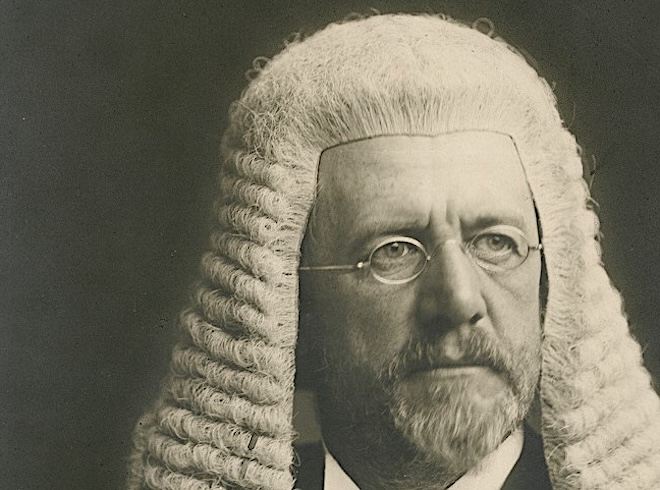
Sammy Way: didn’t want to traipse with the High Court
And it is assumed that John Bray the SA CJ (1967-1978) was offered a place, but declined, presumably on the basis that life in the Barwick High Court lacked the charms of Torrens-side, where the composition of Latin (and English) verse went on at his home in Hurtle Square, along with judgments still cited in the High Court: over 90 such, for recent example Northern Territory v Mr A Griffiths[2019] HCA 7.
As for the poetry: it wasn’t all warmed over Ovid. NSW has its creative judges e.g. George Palmer in musical composition; David Hodgson in philosophy; and WA had Nick Hasluck writing novels.
One wonders how a publicly acknowledged single male bisexual would fare in reaching high public office in the starchier current era, writing the following:
Tobacco: A Valedictory
America to Europe, these: the cocoa bean,
Potatoes, turkeys, pox and nicotine.
The first three make us more diversely fed.
The fourth plants time bombs in the marriage bed.
The bad-mouthed fifth I sing, the leaf that turns to
sneeze and cloud and jet and puff;
Cigars, cheroots and cigarillos, pipes, cigarettes, hookahs
and snuff.King James ascribed its provenance to Hell.
Victorian ladies banned it for its smell.
And now, we’re told, it will erode or coat
The heart, the lungs, the arteries, the throat.
Some poets, though, promote it. Witness the shocking
Words that Kipling spoke.
‘A woman is only a woman but a good cigar is a smoke.’I have renounced it at the doctor’s threat.
Still I pay homage to the cigarette.
It seemed to give assurance, ease and poise.
It filled the awkward hands of graceless boys.
The camaraderie of the match I cite,
The introduction of the proffered light.
Turf, Marlboro, Sterling, Capstans, I confess.
Camels and Country Life gave me delight,
Sobranjes, Stuyvesants and Black and White,
Virginians tight-packed, Gaulois in acrid shreds,
Indonesians tanged with clove,
The shared last butt, the first long waking drag after a
night of love.
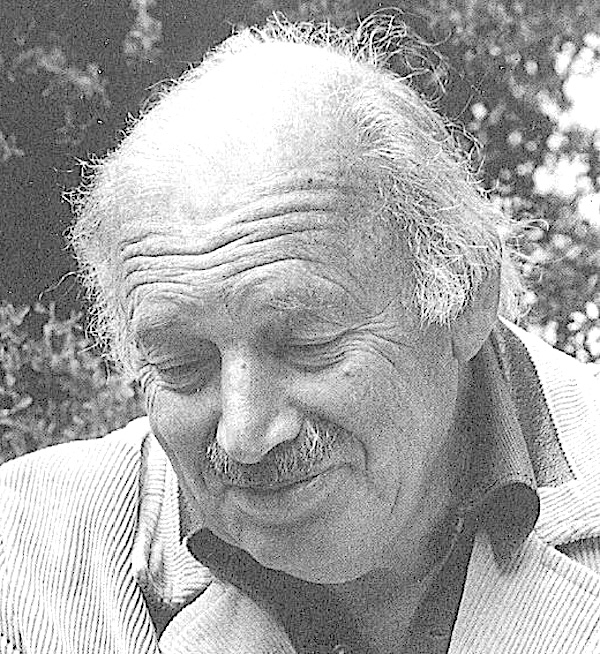
Bray CJ: homage to the cigarette
And St George and the Dragon Discussion Group is a wonderful admonition to any young who may have aspirations to reform the law:
As the young man chafing in armour off the peg
Jogtrotted down the Lydda highway on his hack,
Newly acquired from Ares’ used horse mart,
Fumbling the stiff scabbard and trying to remember
All the demonstrations in the night school on spearcraft,
There accosted him a clutch of learned persons
From various faculties, who thus addressed him.“Wait till all the facts are in. Every Question
Is multilateral. You are overlooking
The dragon’s viewpoint. Non-intervention
Is your only duty, till a commission,
To be appointed in twenty-seven days
By an international body, has reported.”“Dragons are symptoms. They will continue
Till we have socialism. Tilting at dragons
Is mere adventurism. Read Marx on Monsters.” …
“Dragons come from Tartary. Now we have the one.
If he is injured the Grand Cham will avenge him.
We will be invaded by a horde of basilisks,
Cockatrices, mantichores, asps and amphisboenas.
Great sea-serpents will coil along the coastline,
Flailing down the shipping and fissioning the waterfronts.
One princess yearly we find expendable.
Do you want forty virgins crunched a fortnight?”St George turned homeward, somewhat disconsolate,
And took up a career in public relations.
≈ ≈ ≈
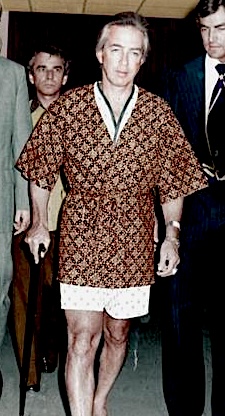
Dunstan: only one name for CJ on the tableIn the ABC archives sits a living history interview with Don Dunstan in age, recounting how he stared down his Cabinet of horny handed boiler makers in 1967 when Sir Mellis Napier was finally to depart.
Dunstan placed only one name on the table as the proposed new chief justice.
There was coughing, and hemming and hawing, but Dunstan simply stood his ground and said that Bray was the best legal mind in the State.
Bill Deane said, when unveiling Roma Mitchell’s statue on North Terrace, that the Bray Court had been the greatest of all State Courts.
Ah well, after the pinnacle must come the descent, allowing for the fact that Len King as CJ (1978-1995) remains also much cited by the High Court.
There may be no Crow Eaters on the High, but the standard of jurisprudence can’t be uniformly bad.
Australia’s Chief Justices are not overly represented in statuary: Sammy Way on North Terrace in Adelaide and George Higinbotham so deservedly outside the Old Treasury Building in Melbourne, but John Jefferson Bray (proud of his descent from Jefferson and so from Pocahontas) is remembered as he wanted, by a bird bath in Hurtle Square across the road from his long time home, replete with one of his verses.
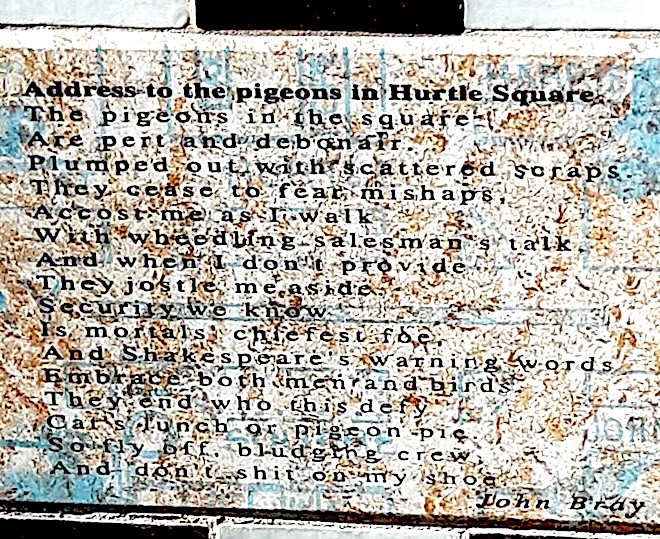
Hurtle Square bird bath: ode to pigeons