So, the Dodger has finally left us, out of the prison hospital in a wooden box, age 83.
One would like to think that this marked a terminal point in the history of the NSW Police. Yet, given that throughout the Wood Enquiry 1993-1995, Manly Police Station (“seven miles from Sydney, a thousand miles from care”) carried on business as usual (green lights for their favourite drug dealer and pet housebreaker, plus the usual licensing fees), probably not.
Let me draw an unlikely arc for you, but one with lessons to be learned – between Idi Amin and Roger Rogerson. One an African despot, the other a suave NSW copper cum killer. What could be the points of commonality?
As recounted to me by an old East Africa hand who had been the junior legal officer in Crown Law, Nairobi – the administrative base for the colonies of Kenya, Uganda and Tanganyika – the time had come in 1962-3 for independence.
The Duke was coming out to see each of these new nations born as self-governing states. The Union Jack lowered, the new flags raised – much pomp and ceremony.
Amidst this lather of goodwill, as independence-day for Uganda loomed in 1962, news reached Nairobi of a massacre in northern Uganda: 40 villagers smoked, and it appeared that the killing had been performed by a platoon of the Ugandan army under command of an indigenous lieutenant, and there were only two of that rare species.
What to do? All too embarrassing to reveal that the colonial power had trained up a psychopath and raised him to commissioned rank. Better to sweep under the carpet, and let the festivities proceed unblemished by this blip.
The young officer’s name? – Idi Amin. He rose through the ranks to the point where he mounted a coup, seized power, and the rest is lamentable history.
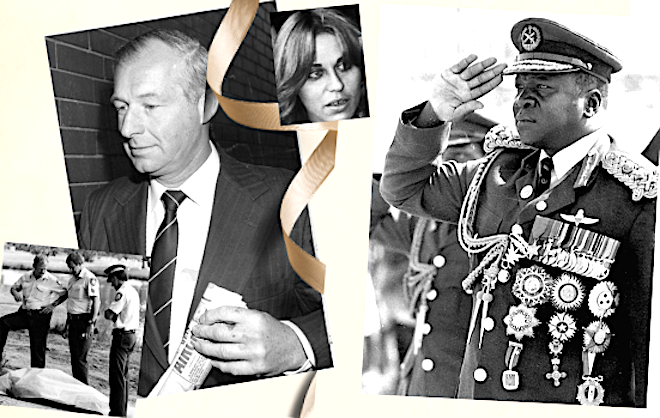
Amin and Rogerson: grotesque misdeeds … a policy of look the other way
For those too young to remember, the Pearl of Africa, Kampala, was trashed, Asian heritage Ugandans were forced to flee (their arrival sparking a constitutional crisis in the UK: passport holders without rights?), and the slaughter of Amin’s enemies so huge that divers had to be brought in to clear the bodies from the hydro-electric turbines where Lake Victoria fed into the headwaters of the Nile.
Meanwhile, in NSW, a young police officer with a can-do attitude was catching attention: the Dodger was on the make.
I note that the recent examinations of Rogerson’s life (hardly eulogies) refer extensively to the well-known slaying of drug dealer Warren Lanfranchi in broad daylight before many witnesses, and the presumed ordering of Sallie-Anne Huckstepp’s death.
The better journalists dug back to record earlier deaths with which Rogerson was involved – but fine details were scarce.
Then my memory was jogged. Mazoe Ford, on the ABC website, wrote: “Rogerson shot and killed three people in the line of duty – bank robber Phillip Western in 1976”, together with Butch Burns and Lanfranchi.
Age lends horizon denied the young, but comes with the curse of clutter and loss of detail. Bells were going off in my head.
The story, as I was told nearly a half century ago, was that the “Robbers” i.e. the Armed Robbery Squad, of which Rogerson was an enthusiastic member, had tracked down Western to a house in Terrigal.
He was a convicted murderer and an armed robber and needed to be apprehended. The story peddled in the media since Rogerson’s death has been that Western was shot as he climbed out of a window of the house, and Roger took the responsibility.
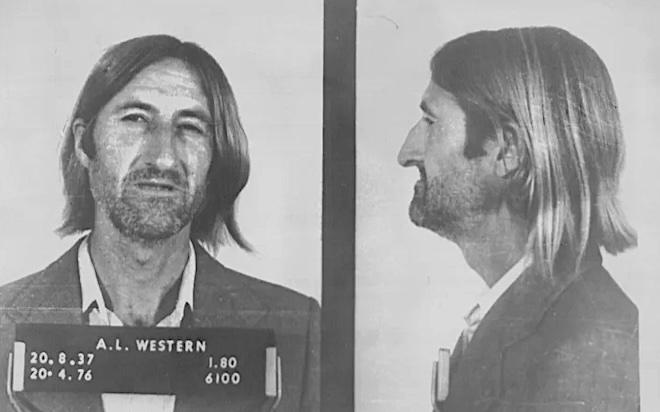
Phillip Western: Rogerson invented the heroics
The backstory as I had been told (not published anywhere) was that the coppers had a plan of the house and fired in tear gas in calculated directions to drive Western to the bathroom, where he could be expected to put his head down in the basin to wash his eyes.
He was then executed through the bathroom window (presumably by Rogerson), his head down. This seems like a plausible manner of disposing of a man who knew too much and might have provided a threat if he was on his feet.
Yet, coming through the bathroom window to die in a hail of bullets sounds much more colourful, romantic, heroic and certainly less cold bloodedly calculating on the part of police.
You may imagine which story Roger handed to the press.
Crime reporter Neil Mercer observed that because Rogerson:
“… locked up a lot of very bad people other police and politicians turned a blind eye to rumours of his criminality for years.”
That’s the point of connection to Idi Amin. For reasons that suit the Great and the Good, grotesque misdeeds of very bad men may be covered up, all on the basis of “the greater good”. We’ve enter the underworld brought to life in the spoof film Hot Fuzz.
Never give a psychopath an even break. They’ll take matters further down the road and out of reach of the law.
It never works out well, but every generation plays along with it. Hitler was tolerated by wealthy German industrialists as he seemed a useful tool in 1933.
We’ll never know the number of murders for which Rogerson was responsible, or cases where he bent the evidence, but it seems he had his fingers in pies as far flung as the Whisky a GoGo arson murders in Brisbane, and the murder of Shirley Finn in Perth (he was seen just after Finn’s shooting drinking in a Perth watering hole with a senior WA detective and Abe Saffron).
I never met Amin, but for some time I found myself daily sharing a lift with Rogerson and his brief, and I enjoyed listening to the Dodger’s voice – very emphatic but with the slightest lisp; a psychopathic killer cop with a speech impediment. Pure Hollywood.
That’s why you should dig out a copy of Blue Murder, Richard Roxburgh’s finest work. He even captures the Dodger’s lisp, along with the swaggering arrogance and the assumption of untouchability.
Magic, but terrifying.