The latest move in the imperial chess game that involves control of the Indian Ocean occurred on October 7, 2024 when the British Foreign Secretary, David Lammy, announced that the Chagos Islands, 1,500 kms south of India and 3,000 kms east of Africa, would now be reunited with the Republic of Mauritius.
The Chagossians (they call themselves Ilois), forcibly removed by the Brits in the late ’60s and early ’70s, would be allowed to make visits, but not to their main island of Diego Garcia.
What on earth has been going on? Senile imperial power picking on some of the very last of its powerless subjects, removing them from their homes and sending them packing? And now generously allowing them to make visits?
The explanation of this sun-setting on Empire nightmare lies in the realisation by the US military in the mid-1960s that the Middle East and south Central Asia were emerging as hot spots that required a US base to deal with them.
The Americans, having entered the great game of Empire building altogether too late, were short on real estate. What to do? A perusal of the globe showed that the central Indian Ocean was geographically proximate for an air base that could deal with problems among the camel jockeys or the Stans (although events were to prove that Afghanistan was more intractable than the generals had imagined).
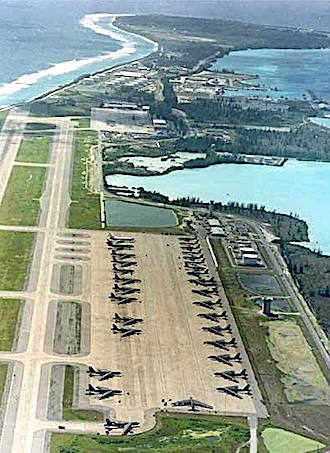
Diego Garcia: big American runwayCloser scrutiny revealed a nice set of islands, the Chagos Archipelago, British territory (picked up from the French after knocking Napoleon over), and with an island, Diego Garcia, large enough for a really big runway and base.
All that was then required was a request to the Brits to allow the Merkins to take over the islands, depopulated, as one couldn’t have pesky local types hanging around one’s sophisticated nuclear air and naval base.
This was happening as Mauritius, then including the Chagos, was heading for independence in the ’60s. The Mauritians said they didn’t care to be launched into their own sovereignty shorn of their northern real estate. The Brits simply made the excision of the Chagos a term of independence. The first simmering resentment.
HM’s Government then pronounced the Chagos to be the BIOT: the British Indian Ocean Territories and, by Order in Council, ordered the few thousand inhabitants off.
The Ilois, a creole people of mixed African, Indian and Chinese heritage leading a simple existence based in a copra economy, were rounded up by the British government, loaded onto boats (700 in one hit), their dogs shot on the beach as surplus to requirements, and taken to Mauritius, where they were not welcome at all.
Over the following years they mostly drifted to the UK where about 3,000 of them ended up living near Gatwick airport. They just wanted to go home. A second massive resentment.
The saga provided the materials for endless litigation, the content of which would be slapstick if the result were not so pathetic.
Led by Oliver Bancoult, the Ilois fought through British courts in the 1990s through the 2010s, twice to the top (House of Lords where they lost 3/2 in 2008, and the Supreme Court in 2018), in US Federal District Courts, and finally in the International Court of Justice.
The ICJ at last provided them with the resounding opinion in 2019, so long denied in UK and US courts, that the excision of the Chagos from Mauritius was unlawful and should be reversed. See: Legal Consequences of the Separation of the Chagos Archipelago from Mauritius in 1965 (February 2019) in which:
“The Court concludes that the United Kingdom has an obligation to bring to an end its administration of the Chagos Archipelago as rapidly as possible …”
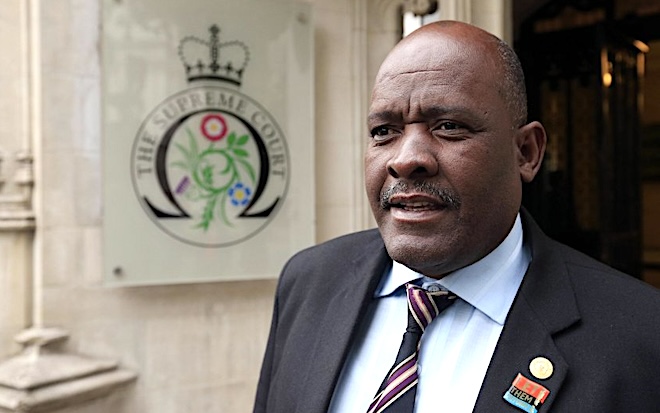
Oliver Bancoult: fighting the Brits in Whitehall
The noises from the British Government earlier in October were belatedly giving effect to that “advice”, and the corollary that the Ilois could “make visits” (although the Yanks were to keep their base, under a fig leaf of joint use with the Brits, so no Ilois to go back to the main island).
Along the way, the litigation dropped some splendid insights into British administrative mores, beginning in 1966, such as this from the Permanent Under-Secretary at the Foreign and Colonial Office which turned up nearly four decades later in Chagos Islanders v Attorney General Her Majesty’s British Indian Ocean Territory Commissioner[2003] EWHC 2222 (appendix).
“We must surely be very tough about this. The object of the exercise was to get some rocks which will remain ours; there will be no indigenous population except seagulls who have not yet got a Committee (the Status of Women Committee does not cover the rights of Birds).
Unfortunately along with the Birds go some few Tarzans or Men Fridays whose origins are obscure, and who are being hopefully wished on to Mauritius etc. When this has been done I agree we must be very tough and a submission is being done accordingly.”
The emergence of woke and political correctness over the decades is wonderfully illustrated in the shuffling of feet away from the phrase “Men Fridays”, as seen in R (on the application of Bancoult (No 3) (Appellant) v Secretary of State for Foreign and Commonwealth Affairs (Respondent)[2018] 1 WLR 973; [2018] UKSC 3, a seven member decision of the Supremes, which one notes couldn’t even make the authorised Appeal Cases.
So much for litigation over a bunch of islanders. This appeal’s casus belli was the use by the Brits of a Marine Zone around the Chagos as window dressing to keep the Ilois and anyone else away.
The Law Lords (and Lady Hale) explored how later civil servants claimed to have avoided any reference to “Man Fridays” when negotiating with the Americans over the future of the Chagos.
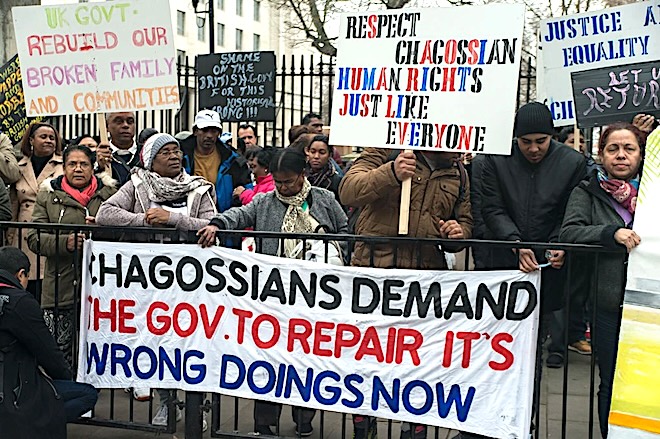
Chagossians potesting in London
The ghost from the 1966 memo just wouldn’t go away and turned up as later usage in Wikileaks, leading to breathless denials in cross-examination that it would ever be uttered by decent chaps in the modern era (it had certainly been used in the Dark Ages of the 1960s).
Despite the insights gleaned by the British courts into civil service attitudes in the wielding of power over defenceless islanders thousands of kilometres away, those courts failed ultimately to deliver satisfactory outcomes to people overborne by Orders in Council, the secretive blunt weapon of Empire.
The Blair government announced that the Ilois could return, but under pressure from the Americans, reneged on that proposal (surprising from such a strongly moral and principled government).
Another Order in Council, passed by the executive government without recourse to Parliament, pronounced fresh law denying the Ilois a return. It was the challenge to that manoeuvre that was the subject of the appeal late in the life of the House of Lords, lost 3/2: R (On the Application of Bancoult) v Secretary of State for Foreign and Commonwealth Affairs[2009] 1 AC 543.
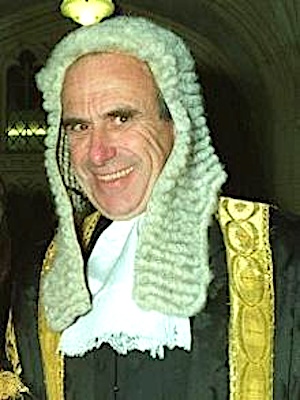
Legover LennieLord Mance, dissenting, even tried to explore the concept of a “trust” falling on the Crown, but Lord Legover Lennie Hoffmann was having none of it as he led the majority to crush the Ilois’ hopes. They still have no right to residence on their home islands.
It is hard to imagine a clearer illustration of the common law’s lack of ability to cope with state power. The British courts happily exposed the chicanery of executive manoeuvres, the bullying and bluster, but never actually delivered. The Crown rolls on unchecked, devoid of any trust restraints in respect of the utterly defenceless and dependent.
Only when the Ilois went to the ICJ did they get a result with teeth, and HM’s Government has finally hoisted the white flag, but only as to reunification with Mauritius: it keeps the base (under a lease from Mauritius) as a preserve for its great and powerful friend and disallows general return of the Ilois.
One notes from Secretary Lammy’s announcement that the US Government was a driver in this settlement, as it was concerned as to the uncertain legal position. Talk about two faced.
Of course the Ilois themselves were never consulted as to the fate of their islands or the possibility of their return.
The Chagos originally emerged onto European maps as a haven for seventeenth century pirates. The saga of the last sixty years reminds that piracy isn’t about flying the skull and crossbones, it’s about a state of mind associated with getting its own way, irrespective of any morality or decency, abetted by a legal system that winked in compliance.
Hmm, I never understood why the seizure of the Tampa by Australian military forces in 2001 wasn’t classed as piracy, but that’s a story for another history reflection.