








Another two year judgment delay from WA’s Hill J … Claims of clarity and recollection need reworking … Rebooting the AAT … Barrister champing at the bit for his (reduced) fees … Theodora’s Goings On
Each delayed judgment was accompanied by boilerplate explanations that her reasons were unaffected by delay, claiming that “it had not been possible to complete the reasons as quickly as I would have liked”.
In each case she took steps to have a “clear impression and recollection of the evidence”; she made “contemporaneous notes; she had the “benefit of written and oral closing submissions”; she did not draw adverse conclusions on credit and reliability based on “demeanour”; and where necessary she listened to recordings.
The latest to join Justice’s Hill’s list of agonisingly slow decisions is Lamers v Arvind Pty Ltd [No 3]. It was heard in October and early November 2020 and delivered two years and three months later, on February 10, 2023.
It was a dispute over the terms of an agreement for the development of property at Sanford Road, Canning Vale, and involved consideration of the powers, duties, rights and liabilities of a trustee, particularly whether a beneficiary knew about a mortgage over the trust property.
Needless to say, it was accompanied by the traditional template explaining that, despite the lapse of time, everything remained crystal clear in HH’s mind.

Frankly, the judge’s claim that her delays do not have an adverse impact on her reasons needs improvement and updating, rather than regurgitating the same old … same old.
For starters, it should contain an apology to the parties for leaving them in a state of anxious suspension. She should also cut out the bit about not being as expeditious as “I would have liked”.
It’s not a matter of what she “would have liked” – the court requires reserved judgments in civil cases to be delivered “as soon as practicable after the completion of the hearing”.
In first instance cases this is “within three months of the last day of hearing” – not two years after that.
You wonder if the management of the WA Supremes has a grip on what’s going on and is providing some remedial assistance to Hill J.

March 8 is closing in fast. It’s the last date for suitable people to put up their hands for appointment to the new administrative review outfit, either as president or a full time member.
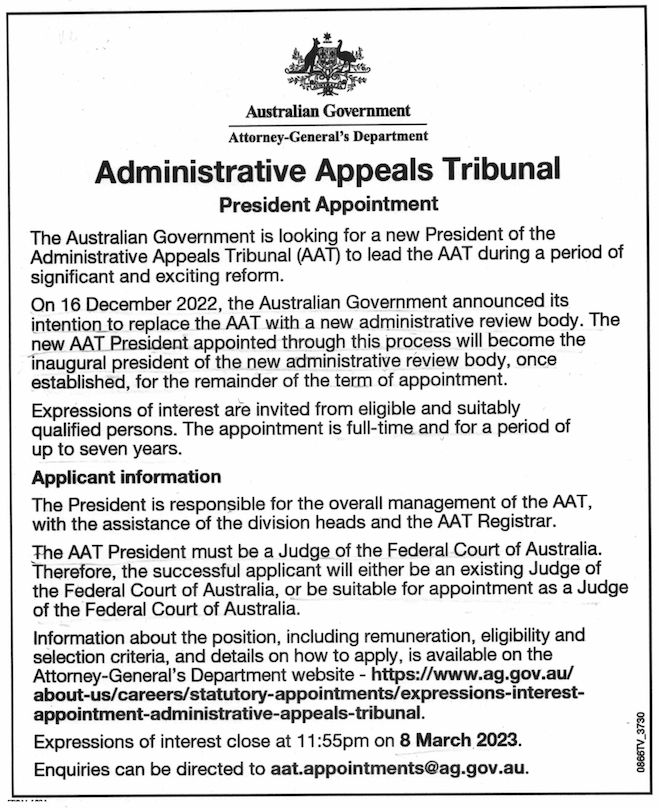

The government’s clean out of the AAT will see 75 additional members appointed to address the backlog of cases, particularly in the migration and refugee division. Others will work primarily in the NIDS or the social security areas.
These will be two year appointments carrying a pay packet of over $256,000 p.a. with the overall cost of rebooting the tribunal with fresh talent put at $63.4 million.
The Guardian reported that about 60 full-time members who are not reappointed could have their contracts paid out, at a cost to the Commonwealth of around $10 million – a small price to pay to get rid of them.
Once appointed the new members will transition to whatever replaces the tribunal – for the remainder of their term.
The hunt is also on for a new tribunal president, following the resignation of Fiona Meagher a fortnight before attorney general Mark Dreyfus pulled the pin on the quasi judicial nursing home for Coalition has-beens and eight months after she was appointed to the $490,000 a year gig.
The AAT had been comprehensively trashed throughout the tenure of attorneys general Bookshelves Brandis, The Christian Porter and Cruella Cash.
An “expert advisory group” has been selected to hammer out the key policy and legislative issues for the reconstituted administrative review arrangements …
Under Dreyfus, the sleepy AG’s Department is now about as busy as it was 50 years ago under Lionel Murphy.
On February 7, Justice Geoffrey Bellew upheld costs assessments that shaved over 40 percent off Bevan’s bill in a bankruptcy related case – upholding a finding that the fees were not fair and reasonable.
For good measure, the judge was helpfully assisted by 2,500 pages of documents submitted by Bevan’s people.
Having been stuck with a miserable assessment of $224,386 out of his original bill of $349,360, Bevan promptly sought to register the cost certificates as a judgment of the court.
Bingham moved to get an interim injunction restraining the barrister from registering the certificates.
Bingham acted for a woman who was seeking to annul her bankruptcy and Bevan had been instructed to advise and appear.
The costs agreement said that the solicitor will only be liable for the barrister’s fees “to the extent that one or more of [the other parties] has put him into the necessary funds to pay the fees”.
Bingham has commenced proceedings in the District Court to recover the fees from the client.
Bevan told Justice Peter Garling that since he has the costs certificates he is entitled to register them and the court cannot prevent him from doing so.
The judge didn’t like that submission at all.
Bingham argued that the retainer agreement is a contract which requires the solicitor to be first put in funds by the client before Bevan sees a red cent.
Garling J said:
“I am persuaded that the solicitor has an arguable case that he has no obligation to pay the funds until such time as he is paid by his client.”
[snip]
“… Indeed, if that be correct, the barrister may never have an entitlement to be paid.”
Bingham v Bevan the latest instalment