


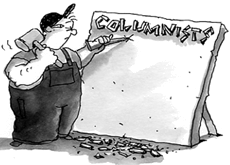





Dire legal aid conditions bring on strikes by criminal briefs in the Old Dart … Barristers reporting incomes below the minimum wage … Delays in payments … Massive exodus from the profession … Magic Circle firms booming and bloated, while criminal justice practitioners go into debt … Misconduct charges threatened by the LCJ … The decay in legal aid outlined by Max Shanahan
Twenty-five years of constant cuts and declining fees, young barristers earning less than the minimum wage, an exodus of professionals and a mountainous backlog in the courts has seen the UK’s criminal barristers, through the Criminal Bar Association, strike for better pay and funding in a justice system left to flounder.
The scene of wigged and gowned briefs picketing Crown Courts across the country made for an unlikely addition to the UK’s summer of discontent. After originally voting in March to begin refusing return work (instructions to appear in cases in which another advocate had initially been instructed as the trial advocate), the CBA escalated its dispute in June.
Eighty-three percent of members voted for an escalating series of “days of action” in which members do not attend court, and do not accept new cases.
Barristers went on strike for two and three days per week in the last fortnight, and will begin striking on alternate five-day weeks indefinitely from the 18th of July.
The current action arises out of a review of criminal legal aid ordered by the Conservative government in 2018.
The Bellamy report, which emerged from the Criminal Legal Aid Review (CLAR), recommended 15 percent increases to fees for solicitors and barristers across the legal aid scheme, describing the system in less than glowing terms:
“The criminal legal aid system is already weakened. Absent a substantial increase in funding, there is a high risk that the system will simply be unable to cope with the challenges ahead.”
The fee increase – to cost £135 million a year – was described by Bellamy as “the minimum necessary as the first step in nursing the system of criminal legal aid back to health after years of neglect”.
Interestingly, since handing down his report in November last year, Lord Christopher Bellamy, former President of the Competition Appeal Tribunal, has been appointed Parliamentary Under Secretary of State in the Ministry of Justice, with responsibility for legal aid.
The government has proposed to implement the 15 percent recommendation by the end of year, but the Criminal Bar Association is demanding an increase of 25 percent, to address a 28 percent fee decline in real-terms over the past decade.
Furthermore, under the current system, barristers are only paid once cases are concluded. With a court backlog that will take years to clear, advocates won’t see any benefit in the short to medium term. For early career barristers – many of who earn less than minimum wage – waiting multiple years to be remunerated for preparation and advocacy in a trial is simply unsustainable.
Therefore, the CBA is arguing that any increase to fees must apply immediately to all ongoing and upcoming matters. Helpfully, in its lawyerly manner, the CBA has provided free legal advice to the government supporting the legality of backdating fee increases.
A spokesman for the CBA told Justinian that the situation is “unsustainable, particularly for the juniors who depend on small hearings, to wait for a meagre amount of money to come through one or two years after the fact”.
Indeed, such is the precarity of the profession, that Bellamy and the CBA have professed concern that there will simply not be enough advocates to sustain the system.
According to the CBA, junior barristers in the first three years of practice earn a median income after expenses of £12,200. They are not paid for preparation work or travel time, which has increased dramatically with widespread court closures.
Once preparation time has been factored in, some junior barristers have reported being paid as little as £5 an hour. Speaking outside the Royal Courts of Justice on Monday, one barrister said “the reality is that junior barristers like me … cannot afford to do this job anymore”.
The struggles of junior legal aid barristers come as city firms increase their salaries to historic highs – Herbert Smith Freehills, for example, last week gave new graduates a 24 percent pay rise, taking them to a £120,000 base salary.
Turned off by unsustainable workloads, near minimum-wage earnings, and countless hours of unpaid work, the number of criminal barristers in the 8-12 years of practice range declined by 47 percent from 2016-2020.
With the impact of the pandemic and continuing structural problems, the CBA estimates that the exodus has accelerated since then.
Experienced members are also leaving the criminal bar – there was a 24 percent reduction in the number of QCs practicing criminal law in the same period.
Indeed, for those who remained, the pandemic forced 83 percent of criminal barristers to go into debt or dip into their savings to survive the period.
The decline in the profession has had a demonstrable effect on the administration of justice – in the year to March 2022, over 1,000 cases in the Crown Court were postponed at the last minute because a barrister could not be found.
The government has, for now, held firm on its offer of a 15 percent fee rise. However, there has been no word on whether Bellamy’s 18 other recommendations will be implemented.
There has been little communication from Justice Secretary Dominic Raab, apart from a statement before the first day of action describing the strikes as “regrettable”.
The CBA has not been able to meet with Raab since October last year, before the release of the Bellamy Report. A meeting was scheduled for Tuesday (July 5) with Courts Minister James Cartlidge, but, to add to the chaos, he joined the tidal wave of ministerial resignations on Thursday, describing the CBA’s action as “wholly disproportionate” in his resignation letter.
Eager to get around the strike, the Department of Justice has attempted to recruit scab solicitors to fill the gap. Such efforts have fallen flat, with solicitors’ groups supporting the strike, and even commencing their own industrial action.
Members of the London Criminal Courts Solicitors’ Association have begun refusing to take new instructions for burglary, assaults on emergency workers and harassment offences in response to the legal aid crisis.
The Lord Chief Justice has threatened misconduct charges for striking barristers, telling his fellow judges to report absent advocates:
“The judiciary is not a party to the dispute between the Criminal Bar Association and the government and will not enter into the substance of the dispute.
“All cases in which there is non-attendance should be referred to the senior presiding judge’s office to consider whether to involve the Bar Standards Board.”
The CBA described the Lord Chief Justice’s stance as “an attempt to intimidate us” and provided legal advice holding that any imposition of punitive or disciplinary measures would amount to a breach of the right to association under the ECHR.
The judiciary hasn’t been entirely hostile however. Some judges have been privately supportive of the CBA’s cause, while others have used time in court to make comments on underfunding of legal aid. Indeed, Dominic Raab was booed at last night’s annual judges dinner when he described the CBA’s action as “regrettable” and “disappointing”.
The CBA’s industrial action has served to highlight not only the neglect of the legal aid system, but the massive inequality within the legal profession.
As elite firms representing corporate clients raise salaries to eye-watering levels, junior criminal barristers – “the most diverse members of our profession” according to the CBA – are leaving in droves.
As a result, vulnerable people in the legal system are left without representation, while victims face an interminable wait for justice.
Alongside the disparity between the corporate and criminal sections of the profession, Lord Bellamy also identified increasing inequality between the defence and prosecution.
As police and prosecution resources grow under a law n’ order government (or ex-government), legal aid funding has dropped away alarmingly. As Bellamy put it:
“If the police and the [prosecution] have additional resources, then for reasons of both principle and pragmatism, the defence should be supported too.”
With a lame-duck government missing over 50 ministers, a distracted Justice Secretary, and strikes scheduled to continue, it appears unlikely that the government will meet the CBA’s demands in the short term.
More than 2,000 court cases have been affected by the days of action so far, and the backlog grows without any sign of a resolution.
The CBA will next strike from Monday-Thursday next week (July 12-14).