


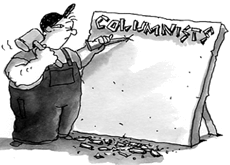





Rebranding The Map’s briefs … Scrabbling for the royal garter gets underway in Tasmania … Clutching at illusory glitter … Peddling the same old malarkey … Status and money raise their unattractive heads
On October 2, a survey was sent by the Tasmanian Bar Council to members wanting to know whether the appointment of queen’s counsel should be reintroduced in the Apple Isle. Needless to say, most of have responded with their ears back.
Fabian Dixon SC is behind the renewed push for the restoration of the royal bauble. He’s a failed Liberal Party candidate for the seat of Denison in 2006 and now practices in the family courts mainly in Melbourne. He also served as a low profile president of the Law Council in 1998.
There are 42 members of the Tasmanian bar, only nine of whom are SCs. The list is adorned by Peter Slipper “BA LLB”, the former scandal plagued speaker of the House of Representatives, who decamped from Queensland and set up shop as a brief in Hobart.
There are another 32 interstate members, according to the Tasmanian bar website, of which four are SCs.
Actually, any number of citizens have no idea what QC means, so it would make more sense to jump to the better understood American description of “Super Lawyer”.
Dixon proposes that Tasmania adopt Victoria’s two step model, with selection by the chief justice on recommendations from a panel of worthies, appointed first as senior counsel, with the option of getting letters patent from the government.
He adds that “it is not a matter which should rely on the approval of the Law Society of Tasmania or the Tasmanian bar … it is a matter for the government of the day”.
You can image the enthusiasm with which the restoration of the regal embroidery would be welcome by a government in Tasmania whose spiritual guidance is drawn from uber right wing string puller, Otto Abetz.
Already a few responses have circulated among briefs nestled along the Derwent. Military man Greg Melick AO SC raises the Star of Courage problem that confronts SCs on a daily basis.
“For those with a military background SC has been confused with ‘Star of Courage’ which had the post nominals certified long before 1993.”
Melick also complains that he lost “at least two potential briefs” because against the best advice of solicitors the clients considered a QC to be superior.
Philip Jackson SC from Malthouse Chambers told his colleagues:
“I have no intention of completing the survey – like all such surveys it does not present appropriate options, is not a satisfactory way to gather truly accurate information, and is more likely than not designed to produce the result those promoting it would like it to produce. But ultimately, the greater problem is that it involves no sort of reasoned debate. In such a small bar, and small profession overall, can we not do better than a survey conducted by a monkey?”
He went on to say that he is not persuaded that change is justified. He has not experienced misconceptions within the profession “where it really matters so far as an independent referral bar is concerned”.
The case advanced by the royal restorationists fails to address the following realities:
In addition, the YES case relies on anecdotes and presents no hard evidence or research to support the switch. The stampede for the imperial knick-knack is infused with insecurity about status. There’s a sad desperation and hollowness to the whole enterprise.
As Bret Walker SC described the pro-QC campaign in 2014:
“… it could not possibly be consistent with the public interest to assuage what might be called the golf-club hankerings of some people …”
The Tasmanian bar sent three attachments to members along with the survey form …