





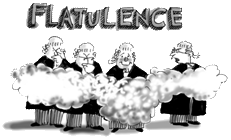


Solicitors losing their grip … Mental health and legal practice … No adequate explanations offered to the stipes … Judges under siege … Where mental health prevents a lawyer dealing with professional complaints … Ticket suspended … Jennifer Cooke reports from the Bureau de Spank
In the NSW Supreme Court on September 14 Justice David Davies found that the director and principal of MN Legal and Management Consultants Pty Ltd did not consider herself to be bound by court rules, and relied on a recent history of mental illness in refusing to participate in a disciplinary investigation into 22 serious conduct allegations.
These included that she illegally recorded court proceedings and sent numerous inappropriate emails, some containing “scandalous” allegations.
After a letter from Judge Gibson’s associate Ms Michail became the subject of a complaint initiated by the Legal Services Commissioner in July last year.
The commissioner notified Ms Michail that she was under investigation and requested a detailed response to the 22 allegations.
These included that she had allegedly made inappropriate communications to and/or about the NSW District Court, the NSW Court of Appeal, Judge Gibson, the Chief Judge of the District Court, Registrar Riznyczok of the Court of Appeal, Justice Arthur Emmett of the NSW Court of Appeal, Tom Bathurst the Chief Justice of the Supreme Court, politicians and other office-holders, legal practitioners, the NSW Police, the Independent Commission Against Corruption and the NSW Department of Justice (Reporting Services Branch).
It was also alleged she had misled and/or attempted to mislead the NSW Court of Appeal about having obtained permission from the District Court to make a voice recording of its proceedings.
Back in 2015, Judge Gibson had struck out several paragraphs of a statement of claim Ms Michail had filed in her own claim of defamation and breach of contract resulting in psychological injury.
When the Court of Appeal refused her leave to appeal from Judge Gibson’s decision, Ms Michail contravened a court order by emailing the judge’s associate and other Supreme Court associates to the effect that “the hearing appeared to be staged” and that the hearing and decision were “not legitimate and I am not bound by them”.
Believing she had been “gaslighted” by the official transcript, she had made her own recordings of the District Court proceedings and that had been done with the “express refusal” of permission from Judge Gibson.
During 2016, the practitioner sent numerous emails to various judges’ associates, registrars and other solicitors impugning the rectitude of members of the judiciary, the Law Society, the police, and various political parties.
Then in February last year, she sent an email to the Chief Justice of the Supreme Court, among others, which “made a number of serious and scandalous allegations against Judge Gibson”.
Attached, and in “serious disobedience” of the Court Security Act and Judge Gibson, HH noted, was one of Ms Michail’s recordings which she declared she was “pro-recording to protect my own legal interests … because evidence I have proves that the courts and all parties are the last entities to preach laws”.
Justice Davies stated:
“. . . if she has a belief about some particular matter, she feels thereby entitled to disobey the law. It is difficult to see how such an approach to her responsibilities as a solicitor is consistent with the inherent requirements of being a solicitor.”
Shortly before Christmas last year, she produced a further letter from Dr Sazhin in which he said he would expect her mental health to deteriorate if she participated in the disciplinary investigation, “re-living her traumas” in relation to her workplace bullying and defamation litigation. Otherwise, he suggested, she was able to perform her professional duties.
The Law Society found that such a rapid recovery seemed “unlikely given [her] long history of depression dating from 2014” during which both her father and sister had died.
Ms Michail applied to the Supreme Court for a merits review of Law Society resolutions early this year to suspend her practising certificate, to request another medical examination and to appoint a manger to her company under sections 270, 282 and 95 of the Legal Profession Uniform Law (NSW).
At the Supreme Court hearing in June this year, she represented both herself and MN Legal. She refused to be cross-examined on her affidavits or to call Dr Sazhin because she could not afford his fee. Nor would she undergo an examination by another doctor at the Law Society’s expense.
In addition to the psychiatric reports from Dr Sahzin, which Justice Davies said were difficult to reconcile, Ms Michail could not direct the court to specifics that justified the allegations in her emails or her insistence that she record court proceedings.
Such conduct was capable of amounting to professional misconduct, and her immediate suspension had been warranted in the public interest, the judge found. He dismissed her action with costs, stating:
“In my opinion, whilstever the Solicitor claims mental health reasons prevent her dealing with the complaints made against her, the decision of the Law Society to suspend her right to practise is entirely justified.”
On the same day as the Supreme Court decision, NCAT found Amil Dlakic, the former principal of Johnston Vaughan in Kogarah, guilty of professional misconduct for the misappropriation of more than $80,000 in relation to three clients as well as other breaches of the former Legal Profession Act 2004.
Admitted in 2000, Dlakic has not practiced since October 2014. His unrestricted principal’s practicing ticket was suspended after a routine trust account investigation raised suspicions of matters including misappropriation, breaching an undertaking, causing a deficiency in the firm’s trust account and breaches of the former Legal Profession Act 2004.
The Law Society sought disciplinary orders against Mr Dlakic arising out of his conduct in relation to the three clients, as well as other matters including failure to provide costs disclosures.
Proceedings were delayed numerous times by Mr Dlakic’s non-attendance and after correspondence from several psychiatrists and a psychologist about his major depressive illness and inability to work, represent himself or give instructions.
When the disciplinary hearing finally began on November 6, 2017, Dlakic did not return after the morning tea adjournment after the tribunal refused his application for at least a year’s adjournment.
The hearing proceeded, pending any appeal or Dlakic’s defence, and taking into account some admissions made to his former lawyers.
In relation to using trust monies for his own use, the tribunal noted each time that Dlakic’s mental health issues did not justify findings lesser than professional misconduct.
Submissions concerning protective and costs orders must be submitted by October 12 pending a second stage hearing.