








 It’s good to have a change of players in the Delay Stakes.
This time it’s the parties who took more than five years to seek a costs determination in the extenuated and convoluted royalty claim brought by Clive Palmer’s Mineralogy Pty Ltd against Sino Iron, Korean Steel, and CITIC Pacific.
The primary action was on foot for about four years before it went for a ten day trial before Justice Kenneth Martin in the WA Supremes.
On November 24, 2017, Martin J delivered judgment in favour of Mineralogy and awarded relief to the tune of hundreds of millions of smackers.
Only last week Justice Michael Lundberg awarded costs. Palmer wanted indemnity costs, but instead got party-party costs, including reserved costs.
Enough to assist in another big round of funding failed dingbat election candidates.

In the process Lundberg had this to say:
“The delay between the primary judge’s disposition of the case on 18 December 2017 and the approach made to the primary judge in January 2022 was around 4 years. A delay of that magnitude is extraordinary and excessive in the extreme.
The overall delay until the application for costs was filed in August 2023 is approximately 5 years and 8 months. I doubt whether the commercial litigation records of this country have seen many similar lapses in time between the publication of a court’s reasons and the ultimate contest on costs. I sincerely hope I am right.
It must therefore be said at the outset that it is far from an attractive or efficient proposition to have a judicial officer other than the trial judge, on a matter of this magnitude and complexity, hear and determine the parties’ competing arguments as to costs, especially after such an inordinate delay. There was ample time for the parties to seek costs orders prior to the filing of the present applications. Both sets of parties are well‑resourced and represented by experienced solicitors and counsel.
Costs issues on such matters should properly be resolved in close proximity to the trial, while the matter is fresh in the mind of the trial judge and the Court is better able to undertake a reliable assessment of the work involved, having regard to the findings made at trial. As will be explained below, the inordinate delay in seeking costs orders in this action, on the part of both the plaintiff and the defendants, is relevant to the exercise of the Court’s discretion to award costs and, in all of the circumstances, is a highly influential factor in the outcomes I have reached.
In my respectful view, simply allowing the parties to any litigation, much less large-scale commercial litigation such as the present action, to decide for themselves when they will choose to run their costs arguments is counter to the goal and objects in O 1 r 4A and r 4B of the Rules of the Supreme Court 1971 (WA) (RSC).”
Kenneth Martin retired from the bench in July 2023 and is now ensconced at Francis Burt Chambers.
President Pete
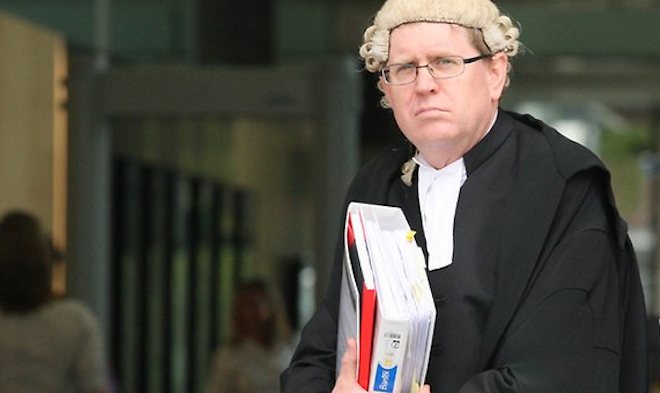
We turn to Justice Peter Davis, president of the Industrial Relations Court of Queensland, who took three years and seven months to come up with a decision about a road worker who in 2014 suffered a cervical spine cord compression injury.
The Workers Compensation Regulator appealed against a decision of the Queensland Industrial Relations Commission, which held that on a proper construction of the Workers’ Compensation and Rehabilitation Act the insurer WorkCover was obliged to refer the injury of the worker, for assessment.
Workers Compensation Regulator v Langridge
Much time was spent on examining whether Michael Langridge was a “worker” who suffered an “injury”.
HH’s reasons comprised great slabs of mind-numbing legislation, with associated gobbledegook.
The insurer, WorkCover, seems to be the fly in the ointment – claiming that Langridge was not a “worker” and therefore didn’t suffer an “injury” at work.
The issue was whether WorkCover had the capacity to reject the application without assessing the injury.
Davis J ploughed his way through the legislation and its amendments and decided that the regulator was right to consider whether Langridge suffered an “injury”, as defined by the WCR Act, when determining whether to refer any injury for assessment.
He added, “Whether Mr Langridge does or does not, as a matter of fact, have an ‘injury’, as defined by the WCR Act, is not an issue before me”.
Most of us would need a bottle of NoDoze to stay awake in an effort to work out what’s going on.
The appeal was allowed. It only took the better part of four years of judicial thinking to get there and 11 years since the “injury”.
Down Hill
 I’m sad to report that Justice Jenni Hill from the WA Supremes has been dragging the chain, again. Maybe there’s a prize
In Frigger v Professional Services of Australia Pty Ltd, an exhausting series of actions since the dispute between the parties blossomed in 2003, there was a hearing in September and October 2023 over two days, with written submissions lodged on October 23 and 24, 2023.
Twenty months later Justice Jenni rejected Mrs Frigger’s application for a summary judgment.
The plaintiff contends, among other things, that the defendant, PSA, never came into existence as a company, and that its instructions in 2010 to wind up her company were not given by a properly appointed director.
Hill J said the whole thing should go to trial and that PSA should be given the offortunivy to adduce evidence on the mouldy events of more than 20 years ago.
Expedition was never Justice Hill’s forte.
Here are some of HH’s priors that Justinian has had the sorry duty to report …
Recusal report – September 23, 2022
Up Hill – October 12, 2022
Western Mail – November 15, 2022
Morpheus arises – February 7, 2023
Delays, fees and rubbish removal – February 24, 2023
Fresh hell – see Hill tops – March 17, 2023
Laments from across the Nullarbor – May 11, 2023
Loitering on the bench – July 21, 2023
From out of the West – September 26, 2023
Close to the source – see Rock and a hard place – December 8, 2023
Slumbering snails – March 15, 2024
The western circuit
Staying in the West we find Judge Antoni Lucev at the Circuit Court is hard at it in catch-up mode.
The judge has been on the snail stakes radar several times before, but it’s fair to mention that he is by no means the slowest on the Circuit bench and has had to cope with illness. Word in the market place is that he is making concerted strides to get on top of the pile.
All we can say is that his most recent batch of reasons from April, May, and June 2025 varied in time between 14 months and 22 months – well outside the required three months expected for judgments.
EJC19 v Minister for Immigration, Citizenship and Multicultural Affairs
[2025] FedCFamC2G 473 (3 April 2025)Hearing 1 September 2023
Judgment 3 April 2025
Time taken: 19 months
EBB19 v Minister for Immigration, Citizenship and Multicultural Affairs
[2025] FedCFamC2G 469 (3 April 2025)
Hearing 28 August 2023
Judgment 3 April 2025
Time taken: 19 months
Balbir Singh v Australian New Zealand College of Anaesthetists
[2025] FedCFamC2G 563 (17 April 2025)
Hearing 5 February 2024
Judgment 17 April 2025
Time taken: 14 months
Balbir Singh v Commonwealth of Australia (Department of Health and Aged Care)
[2025] FedCFamC2G 637 (2 May 2025)
Hearing 31 July and 3 August 2023
Judgment 2 May 2025
Time taken: 21 months
Balbir Singh v Western Australian General Practice Education and Training Limited
[2025] FedCFamC2G 655 (7 May 2025)
Hearing 4 May, 23 and 26 June 2023
Judgment 7 May 2025
Time taken: 22 months
DEJ18 v Minister for Immigration, Citizenship and Multicultural Affairs
[2025] FedCFamC2G 632 (2 May 2025)
Hearing 5 February 2024
Judgment 2 May 2025
Time taken: almost 15 months
DMV22 v Minister for Immigration, Citizenship and Multicultural Affairs
[2025] FedCFamC2G 689 (14 May 2025)
Hearing 21 June and 20 November 2023
Judgment 14 May 2025
Time taken: almost 18 months
DXM19 v Minister for Immigration, Citizenship and Multicultural Affairs
[2025] FedCFamC2G 765 (27 May 2025)
Hearing 21 August 2023
Judgment 27 May 2025
Time taken: 21 months
EJQ18 v Minister for Immigration, Citizenship and Multicultural Affairs
[2025] FedCFamC2G 816 (30 May 2025)
Hearing 19 March 2024
Judgment 30 May 2025
Time taken: 14 months
Armet v CFC Consolidated Pty Ltd (No 5)
[2025] FedCFamC2G 936 (17 June 2025)
Hearing 17, 20 and 21 February, 1, 2 and 3 May and 7 July 2023
Date of last submission: 4 August 2023
Judgment 17 June 2025
Time taken: 22 months
Contravention of the Fair Work Act, with a further hearing on penalty and compensation on 7 August 2025