






News has spread about the Samuel Griffith Society’s August knees-up in Perth, amid mounting protests about the appearance of accused lech Dicey Heydon.
Others on the speakers’ list include Justice John Snaden, one of the Rev Christian Porter’s picks for the Federal Court in Perth; the Rev Porter himself; Hon. Simon Steward; and flat-earth legal academic James Allan – as dedicated a group of dehydrated, knee-jerk reactionaries as it’s possibly to muster.
The society is understood to have been actively lobbying to get Steward onto the High Court. It opposes the expansion of federal government’s power, a republic, Mabo, and the majority decision in Love v The Commonwealth.
The president of the society is the Squire of Dunkeld, Lord Myers.
 His conference appearance has been billed as part of Dicey’s rehabilitation tour following the self-publication of his latest door-stopper on contracts.
Memories will rush back to October 30, 2002, when Dicey gave his High Court job application speech to another organisation of hairy-nosed Tories, the Quadrant dinner.
There he attacked “judicial activism” and senior judges he regarded as unreliable – a speech that made Little Winston Howard quiver with delight.
Three months later Heydon replaced Mary Gaudron on the High Court.
The job application speech was published in the January-February 2003 edition of the Quadrant Magazine – except that it was expurgated.
The edited version is behind the Quad-rant paywall and, frankly, it’s not worth the money. Strangely enough, the cleaned-up version was republished by Otago Law Review in 2004 – available here for free.
The bits chopped out are instructive. Dicey was quite happy for the rheumy buffers at the dinner to hear his swipes and sneers about the High Court and justices he disapproved of, but by the time he was on the court he thought better of having the nasty, bitchy cracks more widely published.
The courage of his convictions was tempered by self-interest snd appearances.
Among the comments he took out for public consumption were his attacks on Sir Anthony Mason.
If Murphy J was the first “deliberate innovator” in the High Court (“justice tempered with Murphy”), he was not the last.
“Among the greatest innovators of them all, until he retired in 1995, was the once cautious Sir Anthony Mason.”
With lips curled Dyce went on to give the well lubricated guests the following waspish observation, which Justinian retrieved from the cutting-room floor:
“Of course there has, with respect, been much admirable work done by the court in the 1980s and 1990s. But, as the French diplomatic phrase has it, I must find another occasion on which to express my esteem. When the court adopted an activist function, the majority judges tended, like other contemporary intellectuals, to claim the two-fold privilege of changing their opinions at will, and of being infallible in every change. The expression ‘judicial consistency’ came to have an oxymoronic quality, like military intelligence or police culture. The condition of the Australian judiciary came to illustrate another of Robert Conquest’s laws: ‘Every organisation appears to be headed by secret agents of its opponents’.”
On he waxed …
“Judicial activism is often associated with young judges, but the most activist of all in our country have been quite old people apparently in a hurry – the majority justices of the Mason High Court. Certainly those judges could seem old. When the young and vigorous Gummow J was appointed in 1995 to replace Mason CJ, on his first day the other judges held a lunch for him. The waiter asked him what he would like. ‘Sirloin steak,’ he said. The waiter said: ‘What about the vegetables?’ He replied: ‘They can order for themselves’.”
[This was a recycled joke originally told about Margaret Thatcher.]
“The High Court presided over by Mason CJ has been much praised even flattered.
When he retired, a three-day conference attended by distinguished lawyers from all over Australia and all around the world was held in his honour. There is a centre at a university law school named after him. His colleague, Sir William Deane, who left the court soon afterwards, has also been flattered.
This is a natural thing. The late Mr Justice Harold Glass used to say that on no account should judicial flattery be interrupted, however unsatisfactory the state of the court’s lists.
Judges like flattery because judges are only former barristers, and the strong egos of barristers require flattery to be applied with a trowel. In the days when Harold Glass was a Queen’s Counsel he was leading Andrew Rogers on one occasion. As they left the court together, Rogers said: ‘Harold, that was absolutely magnificent. That was the best cross-examination I’ve ever seen.’
There was a pause during which silence fell between them. Glass broke it by saying: ‘Well, don’t stop. Go on’.”
Mentions of other judges, bugbears of the paleo-right, were also shredded from the original:
“There are of course special cases. There is Chief Justice Nicholson of the Family Court. Introducing him to the press release was like introducing King Henry VIII to the idea of matrimony. While Nicholson CJ tends to confine himself to the admittedly wide affairs of the Family Court, others believe in speaking out off the bench on much wider questions. One often sees letters to the editor with the statement ‘We cannot be silent’ signed by people, for example Kirby J or Wilcox J or Fitzgerald J or Einfeld J, about whom that was never in question.”
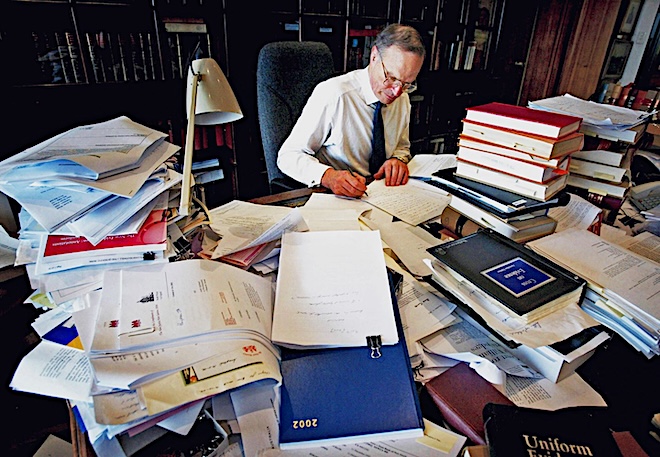
And Kirby, who went on to write a glowing forward to Particular Contracts (“encyclopaedic … brilliant … masterly analysis”) also got it between the ribs at the dinner:
“In his first case in the New South Wales Court of Appeal, a damages appeal from Sully J, Meagher JA dealt with the judgment of Kirby P in the following way. At the end of argument Kirby P uttered the following graceful words: ‘It is quite beyond my ability to improve on the reasons for judgment of the learned trial judge, Mr Justice Sully. I would dismiss the appeal.’ Meagher JA then sadly remarked: ‘This is indeed a most lamentable state of affairs, but I agree that it is quite beyond the ability of Mr Justice Kirby to improve on the reasons for judgment of Mr Justice Sully’.”
By this stage old codgers at the Quadrant feast had tears streaming down their flushed cheeks. It was all too much fun.
The appearance in Perth will be the third sermon by Dicey to the Sammy Griffith cult. He gave the Harry Gibbs Memorial Oration in 2006 and 2013. They can’t get enough of him.
The conference also hosts something called the Sir David Smith Memorial Oration, named in honour of Kerr’s cur, where attendees have been rendered comatose by lectures from Eric (Otto) Abetz and Bookshelves Brandis.
Keith Mason, former President of the NSW Court of Appeal, didn’t think much of Heydon and his contemptuous attacks on other judges, as he made clear in his farewell speech in 2008.
Heydon was sitting stony faced throughout. He was not mentioned by name in the speech, but everyone knew who Mason was talking about.
This piece in The Guardian gave other insights into Heydon.
See also: Party time for Dicey