

Lehrmann claimed there was no sexual intercourse – but if there was, he wants substantial damages
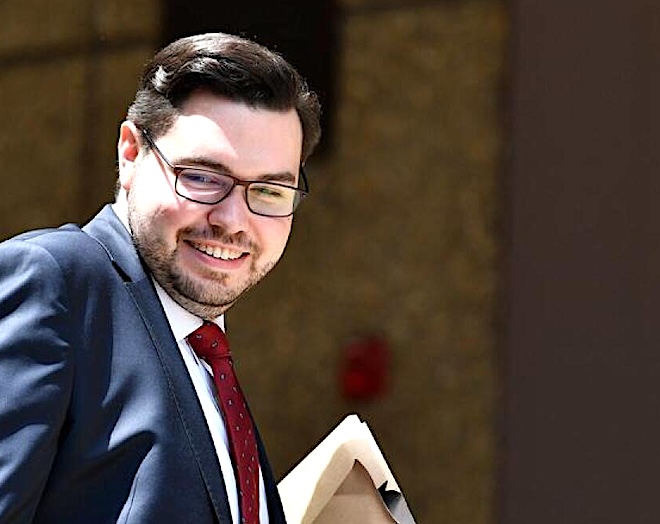
Counsel for former Liberal staffer Bruce Lehrmann have submitted that Lehrmann is entitled to substantial damages from Network Ten and the former host of The Project Lisa Wilkinson over an interview with his former colleague Brittany Higgins even if it is found he engaged in sexual intercourse with Higgins.
The submission was made public on Friday (January 5), when the Federal Court released the closing written submissions from counsel for Lehrmann, Network Ten and Wilkinson.
Lehrmann is suing Network Ten and Wilkinson over a February 15, 2021, broadcast of an interview with Higgins in which she alleged she had been raped by a senior colleague in the office of their then-employer, the Minister for Defence Industry, Senator Linda Reynolds, in March 2019, after a night out drinking with work colleagues.
Higgins also claimed that she had been forced to choose between her career and making a complaint with police.
Network Ten and Wilkinson dispute whether Lehrmann was identified by the program, which did not name him, and otherwise between them plead defences of justification, statutory qualified privilege, Lange qualified privilege and common law qualified privilege.
During a five-week trial before Justice Michael Lee in Sydney over November and December, the Court heard from Lehrmann, Higgins, their former chief of staff Fiona Brown, friends and family, former work colleagues and experts in the form of a toxicologist and pharmacologist and a forensic lip reader, brought in from the United Kingdom to offer opinion on what was said in CCTV footage from a Canberra bar.
The submissions on behalf of Lehrmann squarely addressed credit issues from inconsistencies and dissembling on aspects of his evidence, but said that to describe him as a compulsive liar “significantly and unfairly overstated the acknowledged problems with some aspects” of his evidence.
Addressing Lehrmann’s evidence on where he was when he responded to a show cause notice from Senator Reynolds, his counsel acknowledged this was “undoubtedly unsatisfactory”, saying:
“He appeared to be trying to work out where Dr Collins was going in his questions and not get caught out on matters that he knew could be objectively established. Each of these were, with respect, peripheral issues. His evidence in these respects was dissembling guarded, inconsistent, and lacking credibility.”
Lehrmann told the Court that when he and Higgins entered the ministerial suite after gaining access with the assistance of Parliamentary security, he went to his desk and attended to the annotation of Question Time briefs, and did not see Higgins again before leaving. His counsel submit:
“The fact his evidence as to Question Time Briefs might appear implausible, does not for that reason alone, render it untrue or fantastic or that of a fantasist.”
Counsel submitted that:
“The Court would have no rational basis to find (pursuant to s.140) that any sexual activity, consensual or otherwise occurred. In such circumstances, it inevitably follows that the justification defence must fail.
“When it comes to matters directly relevant to the facts in issue, Mr Lehrmann was it is submitted consistent and unshaken in his evidence. He maintained that upon entering the office he turned left and did not see Ms Higgins again. He rejected every suggestion that there was any sexual activity with Ms Higgins at all.”
Counsel for Lehrmann submit that Higgins was a “fundamentally dishonest witness” such that the Court could not rely on anything she said without independent corroborative evidence. The submissions were also critical of Wilkinson, and The Project producer, Angus Llewellyn.
Addressing the reasonableness aspect of the respondents’ statutory qualified privilege defence, Lehrmann submitted the respondents had strong indications that Higgins was an unreliable source:
“The journalists either wished these problems away or failed to make inquiries and appropriately test and challenge her version of events. The attempt to contact Mr Lehrmann for comment was a fiasco.
“The process of investigation and research, such as it was, found itself infected by confirmation biases. There was no genuine desire to test or check Ms Higgins’ claims to ensure her story was credible.”
Lehrmann submitted that even if the Court should find that sexual intercourse occurred, and that Higgins was not capable of consenting to it because of her state of intoxication, but that Lehrmann did not know this, such findings should not lead to an award of damages which is less than substantial.
≈ ≈ ≈
In their submissions, counsel for Network Ten submitted that:
“Mr Lehrmann was revealed to be a fundamentally dishonest man, prepared to say or do anything he perceived to advance his interests and wholly unconcerned with giving the Court an honest account of the events of 22-23 March 2019.”
Counsel submitted that Lehrmann’s ultimate account of the events of the night in question could not be reconciled with his earlier accounts or the available objective evidence, and in its final incarnation, “was simply ludicrous”.
Counsel submitted that Higgins’ account was “visibly raw, emotional and distressing”, and any attacks on her credit arose from inconsistencies which were explicable by a combination of the effects of trauma and alcohol on memory.
Counsel told the Court:
“There was a palpable rawness and vulnerability to her testimony that was entirety consistent with an honest witness recounting terrible memories. It was the evidence of a young woman in trauma.”
Counsel submit that if the Court is satisfied that Lehrmann and Higgins engaged in sexual intercourse while in Reynolds’ ministerial suite then the intercourse constituted rape, as Lehrmann had not at any time sought consent and, given Higgins’ state of intoxication, his conduct was at the least reckless.
Counsel argue that if the Court concludes that sexual intercourse took place, and whether consensual or not, then Lehrmann’s conduct would be “utterly wicked”, having defended a criminal charge on a wholly false basis, having lied to police and allowed the lie to go uncorrected before the jury, and formed the basis of instructions to cross-examine Higgins at length based on a knowingly false premise.
The false instructions continued to the defamation proceedings, unconstrained by the protections offered to complainants in criminal trials. It was submitted that this amounted to “wicked conduct of the highest magnitude that would … rise to the level of a very exceptional case of abuse of process”.
Counsel submit that the fact of having established the rape is sufficient to deprive Lehrmann of any entitlement to damages. Alternatively, the circumstances would be such that it would bring the administration of justice into disrepute to award Lehrmann any damages.
In submissions for Wilkinson, her counsel told the Court:
“It is apparent from the documents in evidence that Ms Wilkinson depended almost solely on Mr Llewellyn to keep her apprised not only of his research, investigations and fact-checking but also of the views and advice, including legal advice, from others within the broader production team. Mr Llewellyn only informed Ms Wilkinson about what he judged she needed to know.”
Counsel contended that:
“On no view was Ms Wilkinson a decision-maker in relation to any aspect of the final production, broadcast and publication of the matters. Her role in relation to the final broadcast was to read the pre-prepared script, she acted not only reasonably in reading that pre-prepared script but perfectly, in that she read it word for word.”
Addressing her justification defence, counsel for Wilkinson submit that by reason of the toxicology evidence, the Court should find that Higgins was incapable of consenting. They submit that if the Court accepts that Higgins was unconscious when sex was initiated by Lehrmann, then he plainly knew that Higgins was not consenting.
Higgins’ evidence was that she woke up to find Lehrmann engaged in sexual intercourse, and she told him to stop, repeatedly. Counsel submit this indicated a lack of consent, or at least withdrawal of consent.
“If the Court concludes that Mr Lehrmann was aware that Ms Higgins was intoxicated and failed to consider whether she was capable of consent, this would amount [to] recklessness.”
Counsel for Wilkinson further submit that:
“Ms Higgins was forced to choose between her career and the pursuit of justice because of the pressure she felt, because of the culture of silence, leading up to the campaign and not being a team player.”
Counsel for Wilkinson submit that if the Court finds that Lehrmann raped Higgins but a defence of justification is not proved, then no damages would be awarded.
A significant reduction in damages or no damages would also be warranted if there were findings that Lehrmann had engaged in serious misconduct warranting his dismissal from Reynolds’ employ; that Lehrmann and Higgins had engaged in sexual intercourse, which would mean that Lehrmann had perverted the course of justice, and instructed his counsel to cross-examine Higgins on a false basis; and his acts of dishonesty in lying to Brown, Reynolds, Parliament security, friends and family, and to the Court.
Justice Lee has reserved his decision.