




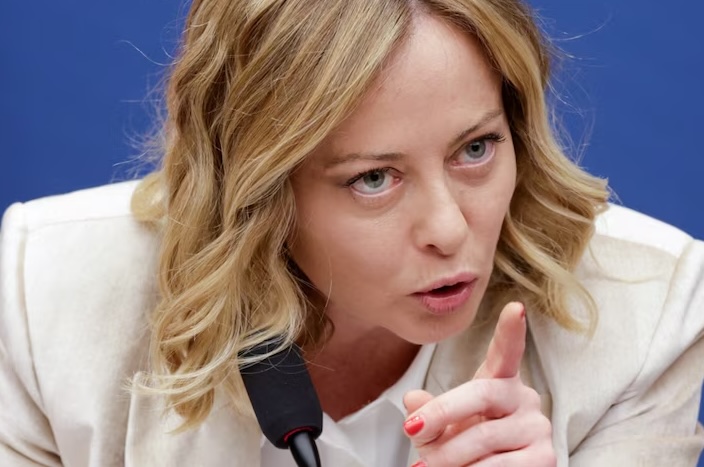
Italian PM Giorgia Meloni
Donald Trump’s pursuit of the lawyers involved in his prosecutions is an ad hominem response to being subjected to legal scrutiny.
In Italy, the government of Giorgia Meloni is going further by trying to implement the dream of the late Silvio Berlusconi and abolish the independence of the whole prosecuting branch of government.
The result in Italy – there were judicial protests from the bench on January 25 and the judiciary is going on strike on February 27, 2025.
In Italy the term “La Magistratura” means the judiciary. Up until 1989, investigating judges or magistrates conducted preliminary investigations into crimes. The best known of these were Falcone and Borsellino – who were assassinated in Sicily in May and June 1992.
Prosecutions are now conducted by a Public Prosecutor (Il Pubblico Ministero), and they have the status of judicial officers (Code of Criminal Procedure Art. 53) and therefore the Constitutional protection of independence from the government of the day.
Conflict between government and the judiciary has a long history in Italy. The only period of peace was during the 17-year operation of the Special Tribunal for the Defence of the State set up by Mussolini and staffed by members of the Italian military and judges selected personally by the Minister for War and by Mussolini.
Over the years there have been many accusations of “red judges” (toghe rosse), but criticism fell away for a few years after massive political corruption was revealed in the 1990s.
In July 2024, against a background of the prosecution of national and regional politicians for corruption and misuse of public office especially by the manipulation of contracts, the Meloni government repealed the offence of “abuse of public office” on the grounds that most such prosecutions were unsuccessful.
Meloni’s government also attempted to remove the Constitutional protection of prosecutors’ independence – however the government parties lacked the necessary two-thirds parliamentary majority needed to amend the Constitution. The proposal could now go to a referendum.
The judicial response to the attempt to remove prosecutorial independence has been impressive.
The National Association of Judicial Officers (ANM), which represents 90 percent of the Italian judiciary, met in December 2024. The ANM resolved on protest action to be undertaken by its members at the ceremonies on January 25 to mark the start of the law year.
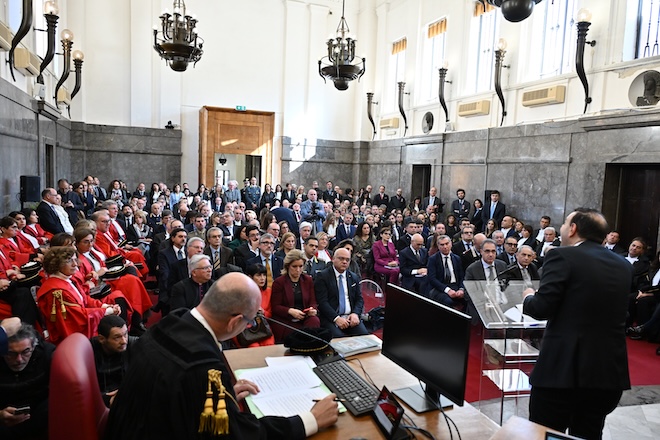
Judges planning their revolt
Across Italy the judges:
- wore the Italian tricolour ribbons on their judicial robes;
- before the ceremony, displayed signs outside the court supporting the values of the Constitution;
- carried copies of the Constitution when they entered the court room for the ceremony; and
- rose together and walked out of the court room as soon as a representative of the Minister for Justice began to speak.
In addition, the National Association of Judicial Officers has declared a one day strike to take place on February 27, 2025.
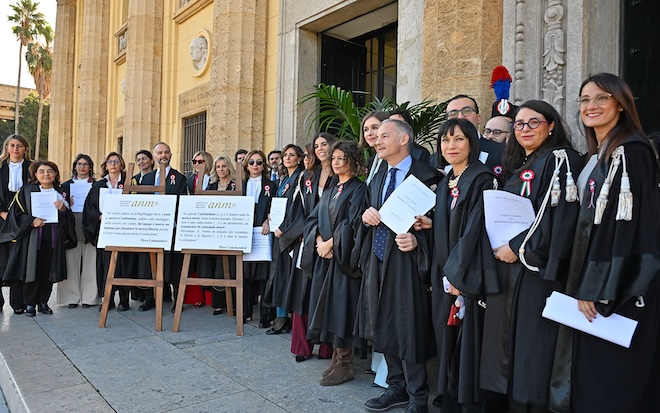
Solidarity – one out, all out
The conflict between the government and the judiciary has increased in the aftermath of Italy allowing the senior Libyan political police officer and accused war criminal Osama Almasri to leave Italy on January 21.
On January 18 this year an arrest warrant for human rights violations was issued by the International Criminal Court, and Almasri was arrested in Turin, on January 19.
The Court of Appeal did not validate the arrest because the Justice Minister Carlo Nordia had not been informed.
Almasri was unexpectedly released on January 21, and repatriated to Libya on an Italian government aeroplane. The Italian government says that the release and repatriation were the result of a decision by the appeal court, and the appeal court says that it was because the Justice Minister failed to respond to a request to participate in the proceedings.
In the aftermath of the Almasri shambles a second front in the war against the judiciary has opened up.
A complaint has been made to the public prosecutors in Rome by an Italian lawyer that the actions of Meloni and two of her Ministers in the Almasri affair amounted to aiding and abetting crimes.
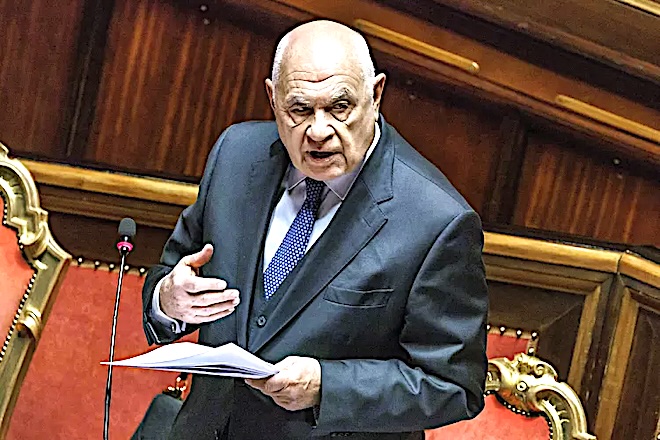
Justice Minister Nordia: “irregularities”
Meloni claimed on social media on January 28 that she was now being victimised and investigated by the same prosecutor who conducted the ultimately unsuccessful prosecution of Matteo Salvini, the leader of one of the parties in her coalition.
The National Association of Judicial Officers has entered the debate – pointing out that the notice Meloni received was not a notice of “being under investigation”. It was a notice that a complaint had been received, and that the prosecutor was obliged by law to notify her that the complaint had been received.