





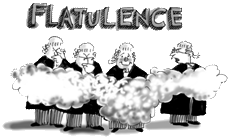



Oh what a tangled web we weave – when we’re a Dutton led Opposition and Dutton fed media.
I refer to the subject of whether convicted non-citizens should be automatically deported: in the words of Dutton when Minister for Home Affairs, “taking the trash out”.
The bloviators in The Whorestralian running in tandem with the Opposition at Question Time, have been baying at the Minister for Immigration over the alleged collapse of western civilisation in our fair land because of his Ministerial Direction 99, which came into play in March 2023.
This Direction to decision makers deals with whether non-citizens who fail the character test (i.e. have been convicted and sentenced to more than 12 months in chokey) should have their automatic visa cancellations revoked.
Direction 99 provides a series of Primary Considerations, number 3 being an extension and embellishment on previous policy directions in this area, and is headed: “The Strength, Nature and Duration of Ties to Australia”.
Under the “taking out the trash” regime run by Dutton, there was scant revocation of the statutorily mandated visa cancellations of convicted non-citizens.
But a significant proportion of those trashed were Niu Zilanders, who’d arrived as toddlers with their families and had no ties to the Shaky Isles.
The Kiwis resented us sending them people who had been the product of life in Oz, lacking connections to NZ apart from the fact of birth.
The impact on individuals was even starker when language differences beyond mere strangled vowels were involved, as in the notorious deportation of a Serb who’d arrived at age two, and spoke no Serbian. His position in his country of birth was parlous.
To avoid the more draconian effects of trash talk and to mend fences with the Kiwis, the incoming Labor government determined to adjust the terms on which convicted non-citizens might remain.

Dutton: talking trash
“Primary Consideration” (PC 3), dealing with the extent of ties to Australia (with an implicit nod to lack of ties to country of birth), added on to a number of existing considerations was hoped to do the trick. Considerations going to the revulsion of the Australian community for particular offences remained, along with what seems to be the progenitor of these considerations, PC 4, “Best Interests of Minor Children in Australia”.
It is PC 4 that gives the clue to where the real tension is coming from in the current brouhaha, as PC 4 emerged from the turmoil around the decision of the Full Federal Court, followed by the even more tumultuous decision of the High in Teoh (1995) 183 CLR 273.
The Last Chance Saloon, with Mason CJ sitting on his last case, lobbed a grenade into the hands of government by saying that the terms of the Convention on the Rights of the Child, giving primacy in decision making to the rights of children, had to be taken into account in the workings of government.
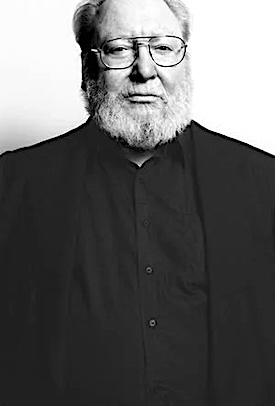
P.P. McGuinness: fulminatorThis provoked rage at the time, with three attempts, all thwarted in the Senate, to legislate the overthrow of Teoh. The late Paddy McGuiness, writing originally in The Sydney Morning Herald and then translated to The Australian, fulminated to the end.
Yet the requirement for primacy of children’s interests still stands, and found its way into formal policy in migration Directions – to the distress of those who believe in the untrammelled power of government to heave out all those who might be heaved if political advantage accrues.
Without mentioning the dreaded name Teoh, we now have a proxy war going on over the assumed political divide between those who know trash when they see it, and the soft touches who think that the circumstances surrounding a non-citizen should be taken into account when addressing their fate.
And thus we have pages, not columns, in The Whorestralian lashing Minister Giles for his Direction 99, and setting out at length references to convicted non-citizens who have been allowed, by decisions of the AAT, to remain in the Sunburnt Land.
Since one Senior Member of the AAT was named in The Oz of May 29, 2024, Emeritus Professor Paul Fairall, as among the guilty, let’s look at the case and his record.
Electronic search shows that since Direction 99 came into play, Fairall has delivered 15 relevant decisions, with 12 in favour of allowing those convicted to remain, and three confirming the decision to remove.
The case referred to in The Oz concerned a Chilean male, MKJQ, who arrived in Australia aged near 30 in 1987. His offences consisted of indecent assaults on his nieces and the child of a family friend between 1998 and 2009.
He was belatedly charged and sentenced to five years non-parole in 2018. Fairall was moved to revoke the visa cancellation by reference to the evidence given by the man’s two children born in Australia as to their need for him here, and psychiatric reports on his low likelihood of re-offending.
Fairall, a peripatetic South African by origin, with a NZ law degree, was foundation Dean of Law in law schools in Townsville, Adelaide and Perth, and may be presumed not a fool.
His decisions to revoke cancellations, as with other AAT Members, are marked by reports as to the unlikelihood of further offending. You’d have to think that MJKQ had tested the limits of official tolerance, but he had lived more than half his life here, was in poor physical and mental health, and his children spoke up.
The Oz on May 30, 2024, continuing the fight, noted a decision of the Hon Dennis Cowdroy (sometime judge on the Land and Environment Court and the Federal Court) in which a Pasifika male succeeded in revocation of visa cancellation only by reference to horrid Direction 99, and in particular CP 3 on ties to Australia.
An examination of the Tavola case reveals that the man arrived at age five from Fiji, was now 33 with a work history here, sufficiently deep for his construction company employer to pay for lawyers to represent him in his visa case.
The real kicker, however, was that Cowdroy dealt with the existence of Tavola’s three minor children and their need to have him here as a father as part of the consideration going to ties to Oz.
This reflects that Primary Consideration 3 is really an outgrowth of the Best Interests of Children consideration.
Quoting Cowdroy on his reliance on CP 3 as proof of the evil in Direction 99 ignores that the law, Direction 99 or not, requires that the best interests of Tavola’s children be taken into account.
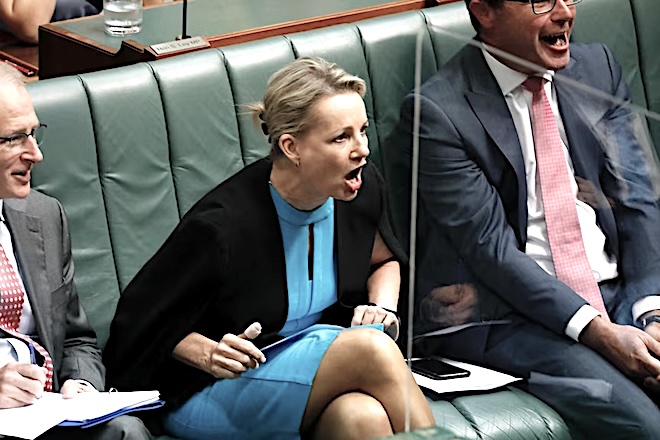
Ley: twaddle
In Parliament on May 30, 2024, Sussan Ley, the Deputy Leader of the Liberal Party, accused the government of having its policy directed by the New Zealand government, which had apparently drafted Direction 99 and imposed it on the hapless Labor Ministry.
This is, of course, twaddle, and Direction 99 may be seen as a rational attempt to determine policy suitable for a humane, modern government to deal with the issue of non-citizens exhibiting criminal behaviour.
The Opposition works from the position of implicitly promising “security” to the Australian community, a promise that must remain empty, as the departure from our prisons every day of hardened criminals who have done their time, secure in Australian birth, reveals to any who stop to think.
Meanwhile, the case that kicked this insurgence off, Teoh, leaves us with a reminder that sometimes clemency and a care for those lacking in power works to good effect.
Three decades later, Teoh’s children, fathered by him in the absence of a mother, are all in good shape, emblematic of how staying the hand of power may bear good fruit.