It was during our somnolent last summer that this column looked at the largesse being scooped up by law firms, well, one in particular, (hello Shine Lawyers), and litigation funders, well, again one in particular, Litigation Lending Services, arising from their involvement in stolen wage cases in the more remote and hence recently settled parts of Oz i.e. Queensland, Western Australia, and now we come to the Northern Territory.
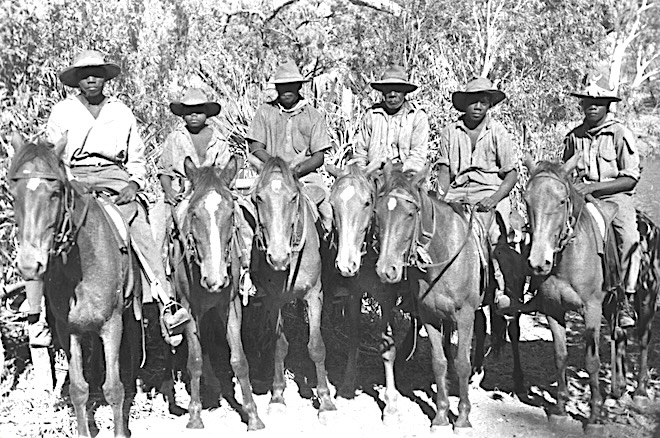
The litigation in issue has been run in the Federal Court as three class actions against the “Crowns” just mentioned, being governments that provided for the pitiful wages proposed to be paid to Aboriginal stockmen to be placed in government run trust funds (as the Blackfellas obviously couldn’t be trusted with the money themselves).
Of course the money was never delivered to the wage earners, and they now being mostly dead, their dependants and descendants have taken to class actions against the governments involved.
Justice Bernard Murphy sat on the cases out of Queensland and WA (Pearson No 2[2020] FCA 619, and Street[2024] FCA 1368), but the most recent case in this trifecta, McDonald v Commonwealth[2025] FCA 380, was decided by Deb Mortimer CJ of the Federales in April this year – Murphy J facing impending statutory retirement.
At stake was whether the Court would accept the proposed terms of settlement between the Commonwealth (as Administrator of the Northern Territory at the relevant times) and an indeterminate number of claimants, guesstimated at 10,000 max.
Murphy J: class action claims against Queensland and WA
Very modern law for attempting to settle large representative (“class”) actions was being run in tandem with some very old law abolishing slavery.
Settlement and discontinuance–representative proceeding
(1) A representative proceeding may not be settled or discontinued without the approval of the Court.
(2) If the Court gives such an approval, it may make such orders as are just with respect to the distribution of any money paid under a settlement or paid into the Court.
The Applicants’ claim contended, among other things, that the NT Ordinances from the 1930s providing for Indigenous workers to be second class (non) citizens, not properly paid for their work, were in defiance of the Slavery Abolition Act 1833 (Imp) (3 & 4 Will IV c 73).
La Mortimer’s task was to determine whether the offer from the Commonwealth of a total of $202 million (inclusive of costs) was to be approved as fair and reasonable.
Talk about working under the sword of Damocles: a refusal to accept the proposed settlement would leave a trial as the only means to resolve the dispute, and the costs of running such a trial did not bear contemplation.
As had been the case in Street, the pattern was litigation funder, LLS Fund Services, demanding 20% of the gross settlement figure, leaving Shine Lawyers to rummage around for its costs of $14.2 million.
Since the Commonwealth wasn’t going to stump up for all of that, the difference ($2.4 million) would have to be deducted from the settlement amount i.e. reducing yet further the (notional) maximum amount to be paid to each claimant: $18,000.
Stockmen: paid in flour and baccy
Of this argy bargy Mortimer CJ said early in her 600 plus para judgment:
“[14] … the Court has a responsibility not to perpetuate … complexity more than is necessary to address the matters which need to be considered. The Court’s reasons should be as accessible as reasonably possible to the range of people who might wish to understand this proceeding and its outcome. These include of course the applicant, her family and community, surviving eligible claimants and their families and communities, the descendant eligible claimants and their families and communities, and First Nations communities … It also includes the Australian community as a whole whose public funds have been applied to the proposed settlement by the Commonwealth, and the media who might report on these matters. The irony, and the matter which needs to change in these kinds of proceedings, is that the complexity arises almost entirely because of the arguments brought to the Court by Shine and the funder, about how much money they should receive because of the settlement of this proceeding, and when and how they receive it.”
The references to the media and the major complexity being caused by Shine and the funder squabbling over their pay packet were prescient. On August 2, 2025 Planet Albrechtsen in full Black Hole mode thundered in The Catholic Boys Daily on the difficulties that would face any actual trial:
“… the stolen wages claims are political, not legal, in nature. It follows that the law, our legal system, is not the right place for governments to make these enormous taxpayer-funded settlements.
And yet there is now a troubling pattern of governments doing precisely that, reaching huge settlements paid for by taxpayers to Indigenous groups under the auspices of a cosy insiders club comprising a bevy of defendant and plaintiff solicitors and barristers, myriad other experts, litigation funders, of course, and judges.
This elite club is allowing the legal system to be co-opted for political purposes.”
Snip.
“… if settlements are to be made to recompense Indigenous people for historical wrongs, they ought to be done in a transparent, honest and rigorous manner. Instead, judges are overseeing an unseemly and faux legal dance where a small group of legal insiders make whoopie with taxpayers’ money.”
Mortimer CJ at [594]:
“It seems to me a not inconsiderable number of people in Aboriginal and Torres Strait Islander communities in the Northern Territory would look at the figures being paid to the lawyers and to the funder … and then look at what their family members are getting at an individual level, and they would be frustrated, and likely mystified about how city-based non-Indigenous participants in this proceeding come out with so much money compared to their family and friends.”
So much for over 600 paras of hard legal slog to explain to the parties and the wider community why a settlement was being approved under the machinery designated by parliament (s.33V of the Federal Court Act), even though the judge had reservations as to the fee taking by the lawyers and funder.
The only way to get something to the claimants was by a settlement: a trial would eat all the possible proceeds.
Albrechtsen: laying down the law
Doc. Albrechtsen completely misses the fact that the lawyers, in this case Shine, are doing the hard slog of finding the claimants and registering them for the representative action.
Teams of para-legals had to comb huge areas of bush looking for descendants of the unpaid stockmen, after having done the hard yards in old government archives to track all the affected parties.
That work didn’t involve a long tea party. Can someone convey to The Planet that collecting those facts was the basis of the “transparent, honest and rigorous” approach that she demanded. That work required payment.
Quoting Mortimer CJ above as to frustration and mystification, Janet moved to the kill.
“Instead of attacking lawyers and litigation funders, the Federal Court’s most senior judge could have raised concerns the legal system is being co-opted for apparently unseemly political purposes.
The only real winners are the lawyers and the litigation funders. And those judges who use the settlements as opportunities to express their deeply felt feelings.”
The newspaper that advertises a claim to aerate competing thought processes once again plays the neo-Trumpian card of attacking unelected judges.
Yes, the sums of money hauled in by lawyers and litigation lenders are eye watering, leading to trivial individual payouts.
But what we get from this columnist is not an analysis of how the indigenous persons and their descendants, so poorly treated in the past, should get fair recompense.
An excoriation of Federal Court judges for doing their job is satisfying for its rabble-rousing effect. It’s also intellectual sloth.
 It was during our somnolent last summer that this column looked at the largesse being scooped up by law firms, well, one in particular, (hello Shine Lawyers), and litigation funders, well, again one in particular, Litigation Lending Services, arising from their involvement in stolen wage cases in the more remote and hence recently settled parts of Oz i.e. Queensland, Western Australia, and now we come to the Northern Territory.